If you have spent any time navigating the modern digital asset or foreign exchange markets, you already know that manual trading is a grind. Staring at charts, managing emotional fatigue, and trying to execute orders manually during high-volatility events usually results in missed entries or brutal slippage. Retail traders are consistently outpaced by institutional algorithms that process order book depth and historical volatility in milliseconds.
Enter Valorstead. Positioned as an advanced, AI-enabled trading environment, this platform is engineered to bridge the gap between complex algorithmic analysis and user-friendly market execution. Rather than just offering another manual charting interface, Valorstead focuses on intelligent execution, specifically upgrading how retail traders approach Dollar-Cost Averaging (DCA), volatility tracking, and cross-market diversification.
Beyond the Hype: What Exactly is Valorstead?
At its core, Valorstead is a multi-asset trading platform and API execution engine. It allows users to trade cryptocurrencies, forex, commodities, and shares from a unified dashboard. But the primary hook—the reason it has gained traction among contemporary traders—is its automated, rule-based execution technology.
Most retail traders approach the market with a calendar-based Dollar-Cost Averaging strategy. They buy a set amount of an asset on the 1st and 15th of every month, completely ignoring what the market is doing at that exact second. If the market is experiencing a massive liquidity drain or a short-term overextension, a standard DCA bot buys anyway, often resulting in terrible entry prices.
Valorstead rebuilds this concept. It maintains the discipline of scheduled accumulation but adjusts the exact timing of the execution within your chosen timeframe based on measurable market states. It doesn’t try to predict the future price of Bitcoin or a Forex pair over the next year; it simply analyzes the current order flow to find the most statistically favorable micro-window to place your trade today.
By offering both a straightforward web interface for manual traders and an API-driven engine for automated execution, the platform caters to both novices looking for plain-language market signals and veterans wanting to deploy systematic trading approaches without writing their own Python scripts.
The Valorstead Facts Table
For a rapid overview of the platform’s technical and operational specifications, review the data matrix below.
| Feature / Metric | Specification Details |
| Platform Classification | Multi-Asset AI-Assisted Trading Terminal & API Execution Engine |
| Minimum Initial Deposit | £250 (or USD/EUR equivalent) |
| Supported Asset Classes | Cryptocurrencies, Forex Pairs, Shares, Commodities |
| Execution Modes | Manual Charting, AI-Assisted Signals, Fully Automated API DCA |
| Security Protocols | Mandatory KYC/AML, App-Based 2FA, Address Whitelisting |
| Funding Methods | Bank Transfer (Wire), Credit/Debit Cards, PayPal, Direct Crypto Deposit |
| API Custody Policy | Non-Custodial via API (Trade/Read-scoped keys only, no withdrawal rights) |
| Target Audience | Beginners needing plain-language signals; Advanced users automating logic |
| Core AI Metrics Tracked | Interval-Relative Volatility, Order-Book Depth (Liquidity), Mean Reversion |
The Core Architecture: How the AI Engine Makes Decisions
To understand if a platform is worth your capital, you have to look under the hood. Valorstead operates on a triad of core data inputs to score a potential trade entry. When running in automated mode, the engine reads these metrics in real-time.
1. Interval-Relative Volatility Analysis
Volatility is often misunderstood as purely negative. In trading, volatility is simply the rate of price movement. Valorstead’s engine doesn’t use static, outdated thresholds to judge if a market is “too volatile.” Instead, it uses interval-relative scoring. It compares the short-window volatility of an asset (say, the last 15 minutes) against a rolling baseline for that specific asset over the past week or month. If an asset is experiencing a sudden, uncharacteristic spike in volatility, the engine recognizes the anomaly. It looks for early signs of mean reversion—the statistical tendency for a price to return to its historical average after a localized extreme—and assigns a higher “Expected Value” score for execution during that reversion.
2. Deep Liquidity Tracking and Order-Book Depth Checks
Liquidity is the lifeblood of efficient trading. If you place a large market order on an asset with a thin order book, your own purchase will eat through the available sell orders, driving the price up against yourself. This is known as slippage.
Before Valorstead executes an automated order, its API reads the live order-book depth of the exchange. It estimates the exact price impact your intended order size will have. If the depth is too thin to absorb your order without significant slippage, the system will dynamically split your order into smaller tranches or delay the execution until liquidity returns to the order book. This alone saves active traders substantial capital that would otherwise be lost to the spread.
3. Rule-Based API Execution
Valorstead is not a custody service for your main portfolio. For users deploying its advanced algorithmic tools, execution happens via API routing. Once the Expected Value score clears your pre-configured threshold, and the order book depth checks pass, the platform places the order directly through your connected exchange using limit logic (where supported). Every single execution is logged alongside the signal state that triggered it, meaning your trading history remains fully auditable. You can look back and see exactly why the AI chose to execute at 2:14 PM instead of 9:00 AM.
The Registration Process: Setting Up Your Account Architecture
Security and compliance are non-negotiable when dealing with financial technology. Because Valorstead bridges traditional finance (fiat onboarding) with decentralized assets, it enforces a strict, heavily regulated onboarding pipeline. Setting up a secure profile is not just about typing in an email; it requires establishing a secure digital perimeter.
Here is the exact, step-by-step registration process required to access the live trading environment.
Step 1: Initial Profile Generation and Data Hygiene
The onboarding phase begins on the official Valorstead portal. You will be prompted to provide foundational details: your full legal name, a primary email address, and a contact phone number.
Operational Advice: Never use a general personal email for a financial platform. Create a dedicated, encrypted email address (using a provider like ProtonMail) solely for your trading accounts. Generate a complex, alphanumeric password exceeding 16 characters, utilizing a mix of symbols, numbers, and varying cases. Do not reuse credentials from your social media or retail accounts.
Step 2: Satisfying Know Your Customer (KYC) Protocols
To operate within global Anti-Money Laundering (AML) frameworks, Valorstead requires full identity verification before you can access live markets or deposit fiat currency. This step separates regulated platforms from shadow exchanges.
You will need to upload a high-resolution image of a government-issued identification document. Acceptable documents typically include a valid Passport, a National ID card, or a Driver’s License. Following the document upload, the system will initiate a biometric liveness check. This usually involves using your smartphone or webcam to map your facial structure, ensuring the person registering matches the ID provided. Depending on your jurisdiction, you may also be required to provide a recent utility bill or bank statement as proof of residence.
Step 3: Hardening Account Security with 2FA
Do not fund your account until this step is complete. Once your identity is verified and your dashboard unlocks, navigate immediately to the security settings. Activate Two-Factor Authentication (2FA) using an offline authenticator application like Google Authenticator, Authy, or a hardware key like a YubiKey. SMS-based authentication is vulnerable to SIM-swap attacks, so app-based 2FA is strongly advised.
Furthermore, you should configure an anti-phishing code—a unique word or phrase that will appear on all official emails from Valorstead so you can instantly identify fake correspondence. Finally, whitelist your withdrawal addresses. This ensures that even if a bad actor gains access to your account, they cannot extract funds to an unknown wallet.
Step 4: Capital Allocation and Funding Your Dashboard
With the gates secured, you can proceed to fund your trading account. Valorstead mandates a baseline minimum deposit of £250 (or the equivalent in USD/EUR). This barrier to entry is intentionally set to ensure traders have enough initial margin to absorb minor market fluctuations without facing immediate liquidation on smaller trades.
The platform supports a wide array of payment rails. You can deposit fiat via traditional bank wire transfers (which may take 1-3 business days depending on your bank), credit/debit cards for near-instant execution, or modern e-wallets like PayPal. For those already in the Web3 ecosystem, direct cryptocurrency deposits are natively supported. All payment options, along with their respective processing times and transparent fee structures, are displayed prior to confirmation.
Step 5: Environment Calibration and Demo Practice
Once funded, the platform does not force you into the live markets. Valorstead features a comprehensive demo environment. This is where you calibrate your preferences. You can adjust your risk limits, define your stop-loss percentages, and choose your operating mode.
If you plan to use the AI features, this is where you configure your daily execution caps and maximum allocation per interval. Spend time in the demo environment getting comfortable with the UI layout, the charting response times, and the way the AI signal dashboard presents data before you transition to risking live capital.
The Trading Experience: Manual Control vs. AI Assistance
Valorstead does not force a single methodology onto its users. It accommodates two distinct types of market participants.
The Manual Trader’s Interface
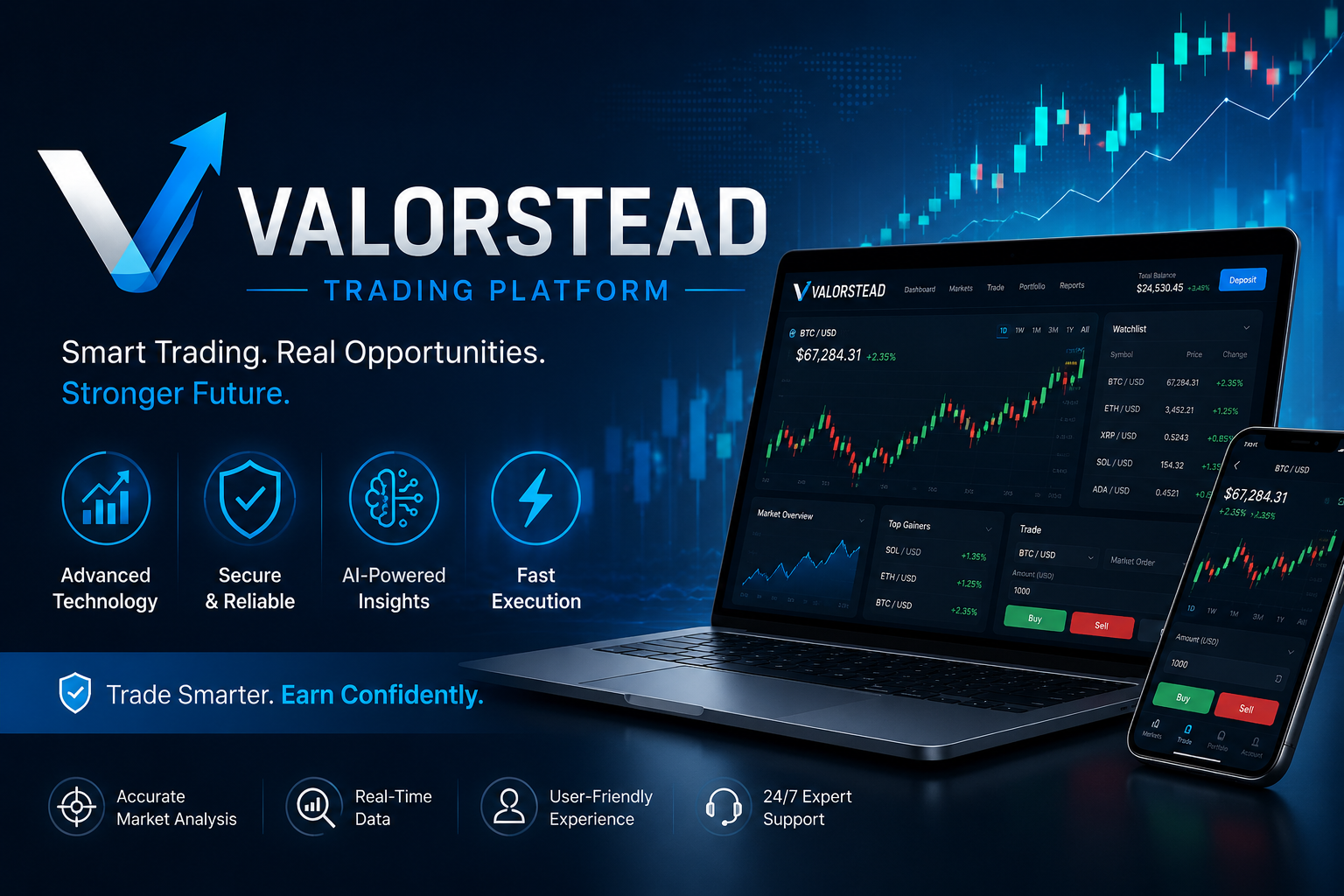
If you prefer to maintain absolute, hands-on control over your portfolio, the platform serves as a highly optimized, low-latency execution terminal. The user interface is stripped of unnecessary clutter, focusing on clarity and speed. It integrates advanced charting tools, live market data, order book depth charts, and historical volume metrics.
Because it operates as a multi-market platform, you can jump from analyzing the EUR/USD forex pair to checking the spot price of Solana (SOL) or a traditional tech stock without having to log out, switch applications, or move funds between different brokers. The technical architecture is built for rapid order processing, ensuring that when you click “buy” during a volatile breakout, the system routes the order swiftly to minimize latency.
The AI-Assisted and Automated Flow
For those utilizing the platform’s proprietary technology, the experience shifts from active charting to systemic management. The platform features an AI insight panel that turns complex market noise into readable prompts. Instead of throwing raw RSI and MACD data at a beginner, the system provides clear “buy / hold / watch” cues alongside real-time risk reminders. For instance, the dashboard might note: “BTC/USD – Volatility is cooling. AI suggests watching the next session before sizing up.”
For advanced users running the DCA engine via exchange APIs, the workflow is entirely hands-off once configured. You assign the engine trade-scoped API keys (meaning the API can only read data and execute trades, but cannot withdraw funds). You set the parameters, and the engine runs continuously in the background, hunting for the optimal micro-seconds to execute your strategy based on the liquidity and volatility metrics mentioned earlier.
Risk Management: Bounding the Impact of Model Error
Any platform claiming their AI is a magic money-printing machine is lying to you. Markets are inherently unpredictable, driven by macroeconomic events, regulatory shifts, and human psychology. Valorstead’s documentation is refreshingly transparent about this: No predictive model is correct every time.
The platform provides a suite of risk management controls designed not to promise a specific financial outcome, but to bound the impact of a wrong signal.
- Circuit Breakers on Abnormal Moves: By default, if an asset experiences a sudden, catastrophic drop or an algorithmic flash-crash, the system pauses execution. It will not blindly buy into a failing asset just because a scheduled interval arrived.
- User-Defined Execution Caps: You can set a hard limit on how much capital the engine is allowed to deploy in a single 24-hour period. If the system spots multiple “highly favorable” setups in one day, it will stop buying once it hits your cap, protecting you from over-exposure.
- Model Drift Monitoring: Financial markets evolve. A trading algorithm that worked perfectly in a 2024 bull market might fail miserably in a 2026 chop-market. Valorstead constantly re-validates its scoring model against recent market data. If the AI detects that recent liquidity patterns are materially diverging from its training baseline (model drift), it flags the asset and temporarily reverts to unweighted, scheduled execution until the system recalibrates.
- Manual Overrides: The user always retains the master kill-switch. You can intervene, halt automated trading, or manually close positions at any given second.
Exploring the Asset Classes
A significant advantage of the platform is its aggregation of global financial markets. Diversification is a core tenet of risk management, and forcing traders to use one app for crypto and another for stocks creates capital inefficiencies.
- Cryptocurrencies (Spot and Margin): Direct market access to foundational assets like Bitcoin (BTC) and Ethereum (ETH), alongside high-cap altcoins and DeFi tokens.
- Foreign Exchange (Forex): Access to major, minor, and exotic currency pairs, allowing traders to capitalize on global macroeconomic shifts and interest rate differentials.
- Commodities: Exposure to traditional hard assets, often used by traders to hedge against inflation or currency devaluation.
- Shares/Equities: Access to global stock markets, bridging the gap between traditional corporate valuations and the fast-paced digital asset economy.
By centralizing these markets, a trader can easily use profits taken from a cryptocurrency swing trade to immediately build a long-term position in a traditional dividend-paying stock, all without facing the friction of inter-exchange transfers.
Frequently Asked Questions (FAQs)
Is Valorstead a scam or a legitimate platform?
Valorstead operates as a legitimate technology provider and trading interface. It enforces standard global financial compliance (KYC and AML) and partners with regulated liquidity providers and exchanges. The platform’s approach to API trading—where it never actually takes custody of a client’s main API funds and only asks for trade-scoped permissions—is a hallmark of a legitimate software infrastructure. However, legitimacy does not equal guaranteed profit; all trading carries the risk of loss.
Do I need prior trading experience to use the AI tools?
No. The platform is distinctly segmented. For beginners, the interface strips away dense terminal jargon and provides plain-language market insights (e.g., “Volatility is cooling, hold position”). Detailed onboarding guides and a robust demo account allow novices to learn the mechanics without risking real capital immediately.
How does Valorstead protect my data and funds?
Security is layered. On the user side, it mandates Two-Factor Authentication (2FA) and supports anti-phishing protocols. On the structural side, any funds deposited directly are handled through encrypted, regulated payment gateways. For advanced users using the platform to manage external exchange accounts via API, Valorstead utilizes read/trade-only keys. The platform physically cannot request or process a withdrawal from your connected exchange, meaning your capital remains securely held by your primary exchange.
What happens if the API connection drops during an automated trade?
If the connection to your underlying exchange experiences a timeout or is interrupted mid-interval, the Valorstead engine automatically halts execution for that specific sequence. It logs the error and waits for the connection to restabilize before re-evaluating the market state. It does not blindly send duplicate orders into the void.
Does the AI guarantee a better average entry price?
Absolutely not. The platform explicitly states that no predictive model is correct every time. The AI is designed to bias your execution toward statistically favorable conditions based on historical data and current order-book depth. While this mathematically reduces slippage and avoids buying the exact top of a local spike, severe macro market conditions can invalidate any model.
Can I run the AI alongside my own manual trades?
Yes. Valorstead only manages the specific allocations and order limits you assign to its automated engine. If you are using API keys, the engine has no visibility over, and will not interfere with, manual trades you place on your own time outside of the configured strategy.
What latency should I expect between an AI signal and the actual execution?
Valorstead is not built for high-frequency trading (HFT) arbitrage where microseconds matter. It operates on interval-level decisions. The latency between a signal triggering and the order hitting the exchange book is standard API routing time (typically a few hundred milliseconds), which is more than fast enough for structural DCA and swing trading, but not intended to front-run institutional HFT algorithms.
Final Assessment: Navigating the Future of Digital Markets
The era of staring blindly at candlesticks and trading purely on gut feeling is ending. Retail traders are increasingly realizing that they are bringing a knife to a gunfight when competing against institutional algorithms.
Valorstead represents the current evolution of retail trading infrastructure. It doesn’t promise impossible returns; rather, it offers institutional-grade mechanics—liquidity tracking, volatility baselining, and automated execution logic—packaged in an interface that a standard user can actually comprehend and deploy.
By allowing traders to step away from the emotional fatigue of the charts while maintaining strict, rule-based exposure to Cryptocurrencies, Forex, and traditional equities, it serves as a highly functional tool for the modern digital economy. Whether you use it purely for its clean manual interface or you hand the reins over to its interval-based DCA engine, proper risk management, strict security hygiene, and continuous market education remain your most important assets.