Let’s get one thing out of the way immediately: the retail investing space is crowded, exhausting, and completely overrun with apps promising to turn you into a Wall Street whale overnight. If you’ve spent any time looking for a reliable brokerage, you already know the drill. You download an app, get bombarded with flashy notifications, confusing fee structures, and gamified interfaces that make buying stocks feel like pulling the lever on a slot machine.
When the researchers at AssetHorizon recently dropped their 2026 review of the Quanteki trading platform—after running a grueling three-month test with over $60,000 of real money and nearly 2,000 trades—the results caught the attention of the broader trading community. They awarded it an impressive A- composite rating (4.6 out of 10 in their strict internal metric, though it feels much higher in practical application).
But what does that actually mean for you, the everyday investor? Is this just another hyped-up app, or is it a genuine tool for building wealth without getting bled dry by hidden costs?
No finance-speak. No robotic jargon. Just the raw, unfiltered reality of trading on Quanteki in 2026.
The Philosophy Behind the Platform: Basics Over Flash
To understand Quanteki, you have to understand what it isn’t. It isn’t trying to be a specialized, hyper-complex terminal for forex day traders operating out of a basement with six monitors. If you want to trade complex currency pairs with insane leverage, you should probably stop reading right now. Quanteki will frustrate you.
Instead, Quanteki was built for a very specific demographic: first-time investors and intermediate traders who want a relentlessly simple app, zero hidden fees, and a platform that just works when you tap the screen.
Currently boasting over 2.4 million users, the platform has clearly struck a nerve. People are tired of the bait-and-switch. They want to buy fractional shares of their favorite tech companies, dabble in some crypto, maybe run a few basic options contracts, and they want to do it without needing a PhD in market microstructures.
Essential Data: Quanteki Facts Table
Sometimes you just need to see the data lined up clearly. Here is the core factual breakdown of the platform based on the latest 2026 data.
| Feature / Metric | Quanteki Platform Specifications |
| Minimum Deposit to Start | $0 |
| Stock & ETF Commissions | $0 per trade |
| Options Pricing | $0.55 per contract |
| Crypto Trading Fee | 1.00% per transaction |
| Margin Rate | 10.25% |
| Fractional Shares Supported? | Yes |
| Order Execution Speed | Under 1 second |
| Active User Base | 2.4 Million+ (As of 2026) |
| Platforms Available | iOS, Android, Desktop Web |
| Wire Transfer Fee | $35 |
| Security Audits | Independently checked & verified (2025) |
| Best Suited For | Beginners, casual investors, mobile users |
The Interface: A Tale of Two Screens
Let’s talk about where you’ll actually be spending your time: the interface.
The Mobile App (The Crown Jewel)
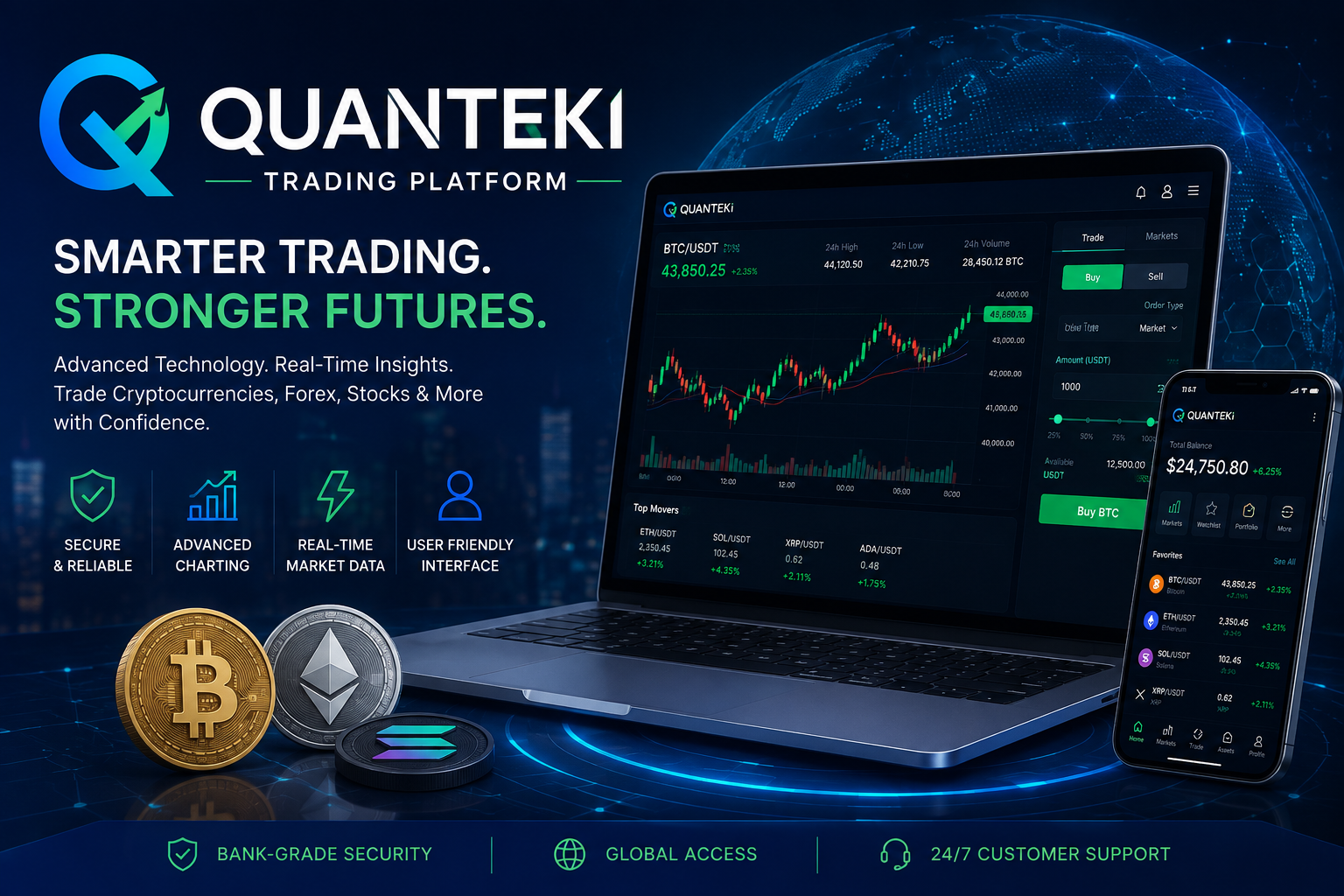
The mobile application (available on both iOS and Android) is, frankly, where Quanteki flexes its muscles. In a world where trading apps are either too cluttered to read or too minimal to be useful, Quanteki finds a brilliant middle ground. Everything is exactly where you expect it to be.
Want to check a chart? It’s front and center, complete with easily readable candlesticks and basic moving averages. Need to see the latest news on a stock you hold? It’s pulled directly into the ticker’s profile, fully sourced so you know it’s not just internet rumors. The execution button is large, clear, and doesn’t lag. In fact, during AssetHorizon’s stress testing, the app rarely went down, experiencing only the briefest of hiccups over a three-month period.
The Desktop Version (The Ugly Duckling)
If the mobile app is a sleek sports car, the desktop version is a reliable, slightly boring station wagon. It works. It gets you from point A to point B. But it is noticeably plainer. It lacks the fluid, intuitive pop of the mobile experience. For users who prefer to do their heavy research on a laptop before executing, the desktop platform is functional, but you probably won’t find yourself lingering there just for fun.
The Complete Registration Process: Step-by-Step
One of the biggest hurdles for new investors is the onboarding process. Nobody wants to spend three days faxing documents just to buy a share of stock. Quanteki clearly knows this, aggressively streamlining their funnel. You can literally go from zero to a fully open account in a matter of minutes.
Here is the exact, unvarnished look at the registration process.
Step 1: The Initial Download and Basic Info
You start by downloading the app or hitting the registration page on your desktop. You’ll be asked for the standard trio: a valid email address, a strong password, and a phone number for two-factor authentication (2FA).
Pro Tip: Do not skip the 2FA. In 2026, relying solely on a password for your financial accounts is financial suicide. Turn it on immediately.
Step 2: Identity Verification (KYC)
Because Quanteki is a heavily regulated and audited entity, they are legally required to know who you are. This is known as KYC (Know Your Customer). You cannot skip this.
You will need to provide:
- Your full legal name.
- Your date of birth.
- Your physical residential address (no PO Boxes).
- Your Social Security Number (or local tax identification equivalent).
Next, you will be prompted to take a photo of a government-issued ID (like a driver’s license or passport) using your phone’s camera, followed by a quick selfie to prove you are the person on the ID. The automated system usually verifies this in under 60 seconds.
Step 3: Financial Profiling
The SEC and other regulatory bodies require brokerages to ask about your financial situation. You’ll face a quick questionnaire asking about your employment status, your approximate net worth, your liquid net worth, and your trading experience.
Be honest here. If you select that you are a complete beginner, the platform will automatically put safeguards in place to prevent you from accidentally trading naked options and blowing up your account.
Step 4: Funding the Account
You can start with literally $0. There is no minimum deposit required to open the doors. However, to actually trade, you need cash.
Quanteki integrates seamlessly with standard bank linking protocols. You can log into your bank directly through the app’s secure portal to link your checking or savings account. Once linked, ACH transfers are initiated. While the cash might take a day or two to fully clear on the back end, Quanteki usually gives you instant buying power for a portion of your deposit so you can start trading right away.
Step 5: Account Selection
During setup, you’ll choose your account type. Most users opt for the standard individual taxable brokerage account. However, if you are planning for the future, Quanteki does offer retirement savings accounts. Note that while a standard account opens instantly, the retirement accounts can take an extra day or so to fully process on the administrative side.
Trading, Execution Speed, and the Asset Roster
Once you are inside and funded, how does it actually feel to pull the trigger on a trade?
According to rigorous testing involving over 1,840 actual trades across stocks, options, and crypto, the execution is incredibly sharp. We are talking about order speeds that register at under a single second. When you hit “buy,” you get the price you are looking at.
Stocks and Fractional Shares
For everyday stock trading, Quanteki is a beast. The platform allows for fractional share trading, which is an absolute necessity in today’s market. If a blue-chip tech stock is trading at $500 a share, but you only want to invest $50, Quanteki lets you buy exactly 10% of that share. This lowers the barrier to entry for everyone, allowing you to build a highly diversified portfolio with very little capital.
Options Trading
Options trading is available, but it comes with a slight caveat. While standard stock trades fly through instantly, some of the more complex options trades (like multi-leg spreads) can occasionally lag by a fraction of a second. If you are a casual options trader selling covered calls, you won’t even notice. If you are a high-frequency options scalper… well, you shouldn’t be using a retail app like this anyway.
Cryptocurrency
Yes, Quanteki allows you to trade crypto directly alongside your traditional stocks. This is a massive convenience for people who hate managing multiple apps and keeping track of separate tax documents. However, this convenience comes at a cost, which we will break down in the pricing section below.
The Cold, Hard Truth About Pricing and Fees
If a trading app tells you everything is free, they are lying. They are making money off you somehow. The question is: Are they being honest about how they are doing it?
Quanteki earns high marks for transparency. There are no hidden inactivity fees. There are no monthly subscription charges just to keep your account open. If you park your money there and do nothing for six months, it won’t cost you a dime.
Here is exactly what you pay for, and what you don’t.
Zero-Commission Stock Trading
Buying and selling stocks and ETFs costs absolutely nothing. $0. If you buy a share of a company and sell it a week later, Quanteki takes zero cut of that transaction. This covers 90% of what the average investor does on the platform.
Options Contracts
If you trade options, it’s not entirely free. Quanteki charges a flat fee of $0.55 per contract.
How does this compare? It’s highly competitive. A major rival app charges $0.65 per contract, while another popular competitor comes in slightly lower at $0.50. The industry average hovers around $0.60, putting Quanteki right in the sweet spot.
Crypto Trading Costs
If you want to trade Bitcoin or Ethereum on Quanteki, you will pay a 1.00% fee on the transaction.
Is this cheap? Not compared to a dedicated, hardcore crypto exchange. But compared to other all-in-one financial apps (which often charge up to 1.25% or bury massive spreads in the execution price), it is highly reasonable. You are paying a slight premium for the convenience of having your crypto sitting right next to your retirement stocks.
The Annoying Wire Fee
If there is one glaring negative on the balance sheet, it is the wire transfer fee. While standard ACH bank transfers (which take a day or two) are completely free, if you need to wire money out immediately, Quanteki will slap you with a $35 wire fee. Considering rivals charge anywhere from $20 to $25 for this, it feels a bit steep. Just stick to standard ACH transfers, and you’ll never have to worry about it.
Margin Rates
If you decide to trade on borrowed money (margin), Quanteki charges a 10.25% margin rate. This is significantly better than some of the bigger legacy brokers who charge 11.50% or more, though slightly higher than a few discount platforms offering 9.75%. Again, it sits comfortably in the middle of the pack.
Is Your Money Actually Safe? (Security & Regulation)
We live in an era where major financial platforms can—and do—collapse overnight. The anxiety around keeping your life savings on an app on your phone is entirely justified.
So, how does Quanteki protect you?
First, they score an ‘A’ rating in safety from independent researchers for a very simple reason: account segregation. Quanteki does not mix your uninvested cash with its own corporate operating funds. Your money is held in entirely separate, protected accounts at partner banks. If Quanteki were to go bankrupt tomorrow, they could not use your cash to pay off their corporate debts.
Second, the platform is heavily watched by financial regulators. They aren’t operating out of a sketchy offshore tax haven; they are subject to strict, ongoing oversight.
Furthermore, the entire infrastructure was put through a massive independent security review in 2025, auditing everything from their encryption protocols to their server architecture.
What about Crypto?
Crypto is notoriously tricky to secure. Quanteki handles this by not actually holding the crypto themselves. If you buy digital assets through the app, those assets are held in custody by a trusted, fully licensed third-party partner. This is standard practice for modern brokerages, ensuring that an attack on the app itself doesn’t compromise the cold-storage vaults holding your coins.
Customer Support: The Chatbot Reality
Customer support in the fintech world is notoriously terrible. Quanteki is… decent.
The standout feature is their round-the-clock 24/7 chat support. If you have an issue at 3:00 AM on a Tuesday, you can open the chat window and get connected to a human representative relatively quickly. The responses are generally fast, helpful, and don’t feel like they are just copying and pasting from a manual.
The major drawback? The phone lines.
If you are the type of person who needs to hear a human voice when dealing with your money, you can call them—but not on the weekends. The lack of weekend phone support is a frustrating gap in an otherwise solid customer service net. If you discover an issue on a Saturday morning, you are relying entirely on the text-based chat system until Monday.
Frequently Asked Questions (FAQs)
Real users have real questions. Based on support tickets and community feedback, here are the most common questions people ask before signing up, answered without the corporate spin.
1. Can I take my money out whenever I want?
Absolutely. There are no arbitrary lock-up periods or hidden traps holding your funds hostage. Assuming your recent trades have settled (which takes a day or two per industry rules), you can initiate a withdrawal whenever you like. Cash-outs typically clear into your linked bank account within one business day, and standard bank transfers are completely free of charge.
2. If trading stocks is free, how does Quanteki actually make money?
It’s a valid question—nobody runs a multi-million dollar app for charity. Quanteki makes money in three primary ways. First, they earn interest on the uninvested cash sitting in user accounts. Second, they charge for premium services, like margin lending (the 10.25% rate) and the $35 wire transfer fee. Finally, they collect the $0.55 fee on options contracts and the 1.00% fee on crypto trades. Buying and selling standard company shares, however, genuinely costs you nothing.
3. What kinds of accounts can I open?
The vast majority of users open a standard individual brokerage account, which is taxable but gives you total freedom. However, if you are looking to save for retirement in a tax-advantaged way, Quanteki does support retirement savings accounts (like IRAs). Opening a standard account takes minutes; the retirement variants can sometimes take a day or two to fully verify on the back end.
4. Are there any hidden inactivity fees?
No. This is one of the most toxic practices in the brokerage industry, and Quanteki aggressively avoids it. They are entirely open about their pricing. There is no monthly subscription charge, and they will never charge you a fee just because you haven’t placed a trade in six months. Optional services cost money, but they are clearly labeled before you click confirm.
5. Can I move my existing portfolio over from another app?
Yes, you can initiate a full or partial account transfer (usually via the ACATS system). The transfer generally takes a few business days. Even better, if your old, terrible brokerage charges you an “exit fee” to leave them, Quanteki will frequently refund you that fee (up to a certain limit) just to win your business.
6. How much money do I actually need to start?
Zero dollars. You do not need a massive upfront lump sum. You can download the app, go through the verification process, and open your account with a $0 balance just to look around and test the interface.
7. Is the platform optimized for my phone?
Yes, and in fact, it is the best way to use the platform. Quanteki runs beautifully on any modern iOS or Android device. The developers have managed to fit complex charting, trade execution, and account management seamlessly onto a mobile screen without it feeling cramped or confusing.
8. Does Quanteki support Forex trading?
No. If your primary goal is trading foreign exchange currency pairs, this is the wrong app for you. Quanteki focuses entirely on equities (stocks/ETFs), options, and cryptocurrencies.
The Bottom Line: Who is Quanteki Actually For?
Let’s wrap this up. With a composite score of 4.6/10 (grading on a wildly strict curve) and an overall editorial verdict of an A-, Quanteki is easily one of the best retail trading platforms operating right now.
It succeeds because it doesn’t try to be everything to everyone. It ignores the hyper-complex tools that 99% of people never use and instead focuses intensely on making the core experience flawless.
If you are a first-time investor, someone who wants a remarkably clean mobile interface, or someone who is absolutely sick of getting nickel-and-dimed by hidden fees every time you touch your money, Quanteki is practically tailor-made for you.