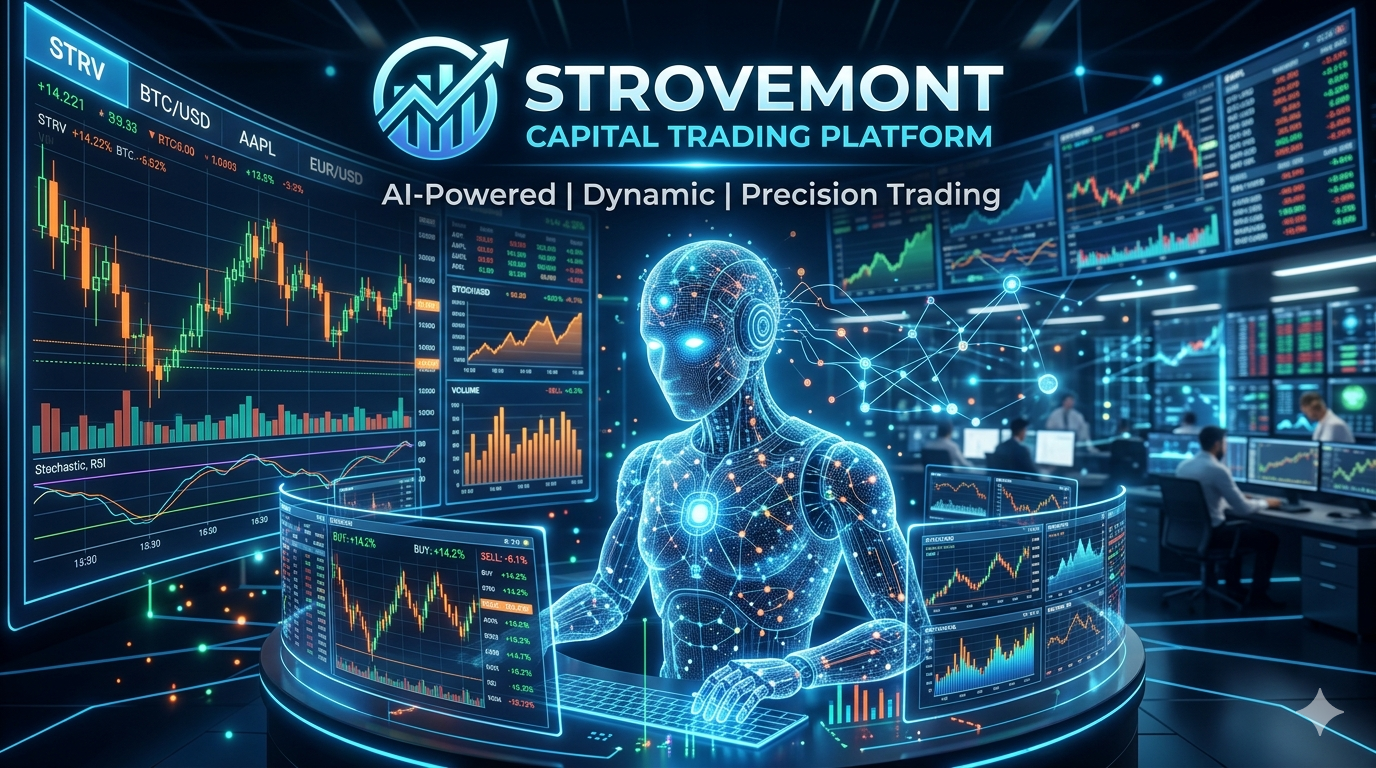
The financial trading landscape has undergone a massive transformation in recent years, heavily influenced by the rapid integration of artificial intelligence, machine learning, and high-speed data processing capabilities. As retail and institutional investors alike seek out more sophisticated tools to navigate increasingly volatile global markets, a new generation of trading platforms has emerged to meet this demand. One of the most discussed platforms in 2026 is Strovemont Capital, a modern digital trading environment designed to facilitate seamless access to global financial markets through an advanced algorithmic infrastructure.
Whether you are a novice investor seeking structured trading environments or a seasoned quantitative trader evaluating API connectivity and automated execution paths, this article will serve as your ultimate resource for understanding what Strovemont Capital brings to the table in 2026.
The Evolution of Digital Trading in 2026
To fully understand the positioning of Strovemont Capital, it is essential to first contextualize the broader evolution of digital trading platforms. Over the past decade, the democratization of finance has led to a surge in retail trading applications. However, early platforms were largely manual, requiring users to stare at charts for hours, execute trades by hand, and rely on delayed market data.
As market efficiency increased, the gap between institutional trading desks (equipped with multimillion-dollar algorithms) and retail traders became a glaring pain point. In 2026, the trend has shifted toward platforms that democratize not just access, but also methodology. Fintech platforms now embed machine learning-driven strategies to level the playing field. Strovemont Capital fits perfectly into this broader trend, positioning itself as an AI-driven solution that packages automated trading algorithms alongside manual execution options, delivering institutional-grade analytics to a wider audience.
What is Strovemont Capital?
Strovemont Capital is a multi-asset digital trading platform designed to bridge the gap between complex algorithmic trading and user-friendly interface design. Built around precision-driven execution systems, the platform integrates real-time market data, intelligent signal processing, and automated trade functionalities within a unified, web and mobile-compatible dashboard.
Rather than functioning as a single-purpose tool, Strovemont Capital acts as a comprehensive ecosystem. It allows users to interact with a wide array of financial instruments through a streamlined, data-centric environment. At its core, the platform operates using structured data analysis models that interpret price movements, liquidity shifts, and volatility patterns across multiple asset classes. This enables the generation of actionable insights that traders can use to make informed decisions, or that the system can use to execute trades autonomously based on predefined parameters.
The Core Philosophy
The core philosophy behind Strovemont Capital is operational clarity and data-driven decision-making. By reducing the noise and emotional interference often associated with manual trading, the platform seeks to provide a structured framework where trades are executed based on statistical probabilities and mathematical frameworks rather than speculation.
Strovemont Capital Facts Table
For a quick and objective overview of what Strovemont Capital offers, consult the facts table below. This structured data summarizes the platform’s core operational metrics based on available 2026 data.
| Feature / Metric | Strovemont Capital Platform Details |
| Platform Type | AI-Driven Multi-Asset Digital Trading Platform |
| Primary Technology | Algorithmic Engine, Machine Learning, Real-Time Analytics |
| Supported Assets | Cryptocurrencies, Global Stocks, Market Indices |
| Execution Modes | Manual Order Entry & Automated/Algorithmic Execution |
| Minimum Initial Deposit | $250 (Required to activate live trading) |
| Subscription Pricing | Basic Plan starting at $250/month |
| API Connectivity | Yes, available for programmatic trading and 3rd party integration |
| Platform Accessibility | Web-based Dashboard and Mobile Client Compatibility |
| Customer Support | 24/7 Multilingual Support |
| Security Protocols | Advanced Encryption Standards, Strict KYC/AML verification |
| Regulatory Touchpoint | CySEC (Verification recommended before institutional use) |
| Free Trial Options | Limited / Subject to platform availability |
Deep Dive into Core Features and Technology
To evaluate the legitimacy and utility of Strovemont Capital, one must look under the hood at the technological infrastructure that powers the platform. The platform is built on several key technological pillars:
Real-Time Analytics Engine
One of the most heavily promoted capabilities of Strovemont Capital is its real-time analytics engine. In modern trading, latency is the enemy. A delay of a few milliseconds can mean the difference between a profitable trade and a significant loss, especially in high-frequency trading scenarios. The analytics engine within Strovemont Capital is designed to continuously process large volumes of market data from global financial exchanges.
It tracks variables such as:
- Price Fluctuations: Minute-by-minute changes in asset valuation.
- Volume Metrics: The number of shares or contracts traded within a specific timeframe, indicating the strength behind a price movement.
- Liquidity Indicators: The ease with which an asset can be bought or sold without affecting its price.
By synthesizing this data in real-time, the platform identifies patterns, price trends, and potential trading signals, ensuring users have access to up-to-date insights aligned with current market conditions.
AI-Driven Algorithmic Engine
At the heart of the system is its algorithmic engine, which evaluates market conditions based on predefined mathematical frameworks. These frameworks are not static; they utilize adaptive learning components. This continuous feedback loop means the system can refine its analytical processes based on new data inputs, learning from past market behaviors to improve future predictive accuracy.
For engineers and data scientists evaluating the platform, this implies the use of machine learning models—likely supervised learning algorithms trained on historical price data and reinforcement learning models optimized for trade execution. These models analyze variables such as trend direction, volatility levels, and historical price behavior to generate signals.
Automated and Manual Execution Systems
Strovemont Capital supports a hybrid approach to trading. Users can choose to execute trades manually, utilizing the platform’s insights and dashboard analytics to guide their decisions. Alternatively, they can leverage automated execution technology.
By setting predefined parameters (e.g., “Buy Asset X when its 50-day moving average crosses the 200-day moving average, with a stop-loss of 2%”), the platform can execute trades on behalf of the user. This reduces reliance on manual input, minimizes delays, and ensures that trading actions are aligned with live market conditions, particularly during periods of rapid market movement or outside of standard trading hours.
API Connectivity for Programmatic Trading
For professional traders, algorithmic developers, and institutional clients, API access is a non-negotiable feature. Strovemont Capital provides robust API connectivity, allowing users to integrate third-party tools, custom algorithms, and external analytics software directly with the platform’s execution engine.
For machine learning and engineering teams, this illustrates common production requirements: low-latency order routing, reliable market data feeds, robust API rate-limiting, authentication protocols, and auditable execution logs. Practitioners evaluating this deployment should, of course, verify API rate limits and order execution paths before committing significant capital.
Multi-Asset Capabilities: Consolidating the Portfolio
A significant advantage of Strovemont Capital is its multi-asset support. In the past, traders often had to juggle multiple accounts across different brokerages to access various markets—one platform for cryptocurrencies, another for traditional equities, and yet another for forex or indices. Strovemont Capital consolidates these asset classes into a single interface.
Cryptocurrencies
The digital asset market operates 24/7 and is characterized by high volatility, making it an ideal environment for algorithmic trading. Strovemont Capital supports a range of cryptocurrencies, allowing automated strategies to capitalize on price inefficiencies and market movements at any time of day or night.
Stocks and Equities
For traditional investors, the platform provides access to global equity markets. Users can apply AI-driven sentiment analysis and quantitative models to evaluate technology stocks, blue-chip companies, and emerging market equities. The ability to mix manual stock picking with automated risk management tools is a major draw for retail investors.
Indices
Trading indices (such as the S&P 500 or the NASDAQ 100) allows investors to gain exposure to broader market trends rather than individual company performance. Strovemont Capital’s algorithmic engine is well-suited for tracking macroeconomic indicators and executing trades based on index volatility.
By enabling users to manage various financial instruments within a single interface, Strovemont Capital simplifies portfolio management, improves operational convenience, and allows for complex cross-asset hedging strategies.
Security, Trust, and Regulatory Compliance
In the realm of digital finance, security and regulatory compliance are paramount. The collapse of several high-profile platforms in the early 2020s has left investors rightfully cautious. Strovemont Capital addresses these concerns through a structured security-first framework.
Data Encryption and System Integrity
The platform employs advanced encryption standards (AES) to safeguard user data, financial activity, and intellectual property (such as proprietary trading algorithms). This ensures that sensitive information remains protected during both storage and transmission, mitigating the risk of unauthorized access or data breaches.
KYC/AML Procedures
To maintain a secure trading environment and comply with international financial regulations, Strovemont Capital enforces standard Know Your Customer (KYC) and Anti-Money Laundering (AML) identity verification protocols. Account activation requires users to provide legitimate identification documents, ensuring transparency and accountability on the platform.
Regulatory Touchpoints
According to available reviews and platform claims, Strovemont Capital lists CySEC (Cyprus Securities and Exchange Commission) as its regulatory touchpoint. The presence of a stated regulator is a positive signal, as it implies adherence to certain operational standards, dispute resolution mechanisms, and financial safeguards.
However, as noted by independent data science and fintech analysts, practitioners should always demand independent performance audits and verify proof of regulatory registration directly with the regulatory body before migrating proprietary strategies or committing large sums of capital.
The Registration Process: Step-by-Step Guide
Getting started with Strovemont Capital requires a structured onboarding process designed to establish user security, verify identity, and configure trading parameters. Here is the comprehensive step-by-step registration process.
Step 1: Account Registration
The first phase involves creating your secure account profile. Users must navigate to the official Strovemont Capital website and complete the initial registration form. This requires basic details, including:
- Full Legal Name
- Valid Email Address
- Contact Phone Number
- Creation of a strong, secure password.
Step 2: The Verification Process (KYC)
Due to strict financial regulations and the platform’s security-first framework, all users must undergo a verification step before live trading can commence. This KYC (Know Your Customer) process typically involves:
- Email Verification: Clicking a secure link sent to your registered email.
- Document Verification: Uploading a government-issued ID (Passport, Driver’s License) and a proof of residence (Utility bill or bank statement). This step ensures compliance with Anti-Money Laundering (AML) protocols.
Step 3: Making the Initial Deposit
Once the account is verified, users must activate their trading capabilities by funding the account. Strovemont Capital requires a minimum initial deposit of $250. This capital is not a fee; it is your trading capital, which will be used to execute trades in the live market. The platform supports various payment methods, including bank transfers, credit/debit cards, and, in some regions, cryptocurrency deposits.
Step 4: Platform Configuration and Risk Setup
Before activating automated algorithms, users are guided through a configuration dashboard. This is a critical step where you define your risk tolerance. You will set parameters such as:
- Risk Levels: Conservative, Moderate, or Aggressive.
- Trade Size: The maximum amount of capital to be allocated per trade.
- Asset Preferences: Selecting whether the algorithm should focus on crypto, stocks, indices, or a mix.
- Stop-Loss and Take-Profit Limits: Crucial safety nets to protect your capital from sudden market downturns.
Step 5: Live Trading and Monitoring
With the account funded and parameters set, users can transition to the live trading dashboard. Here, you can monitor the real-time analytics engine, view tracking logs, observe system uptime, and track the performance of both manual and automated trades in a structured, user-friendly interface.
Evaluating the Pros and Cons
No trading platform is perfect, and a thorough evaluation requires a balanced look at the advantages and potential drawbacks of using Strovemont Capital.
Pros of Strovemont Capital
- Advanced Real-Time Data Analytics: The platform eliminates latency, providing users with the most up-to-date market data necessary for precision trading.
- Automated Trade Execution: The ability to run strategies 24/7 without manual intervention removes emotional bias and ensures trades are executed at the optimal moment.
- Multi-Asset Support: Managing crypto, stocks, and indices from a single, unified interface simplifies portfolio diversification.
- Robust API Access: For developers and quantitative analysts, the API connectivity allows for deep integration and the deployment of proprietary models.
- Structured Dashboard Design: The user interface is praised for presenting complex market indicators and price movements in a clear, straightforward format.
- Strong Security Protocols: AES encryption and strict KYC procedures protect user data and funds.
Cons and Risk Factors
- Market Dependency: Like all trading systems, performance is heavily dependent on market conditions and volatility. There are no guaranteed profits.
- Cost Barrier to Entry: The initial $250 deposit, combined with a base subscription plan of $250/month makes this a relatively expensive platform for casual, low-volume traders.
- Configuration Sensitivity: The success of automated execution is highly influenced by the parameters set by the user. Poor risk configuration can lead to significant losses.
- Limited Free Trials: The lack of extensive free-trial options makes it difficult for users to backtest the platform’s proprietary algorithms without committing capital upfront.
- Transparency Gaps: Independent performance audits and public disclosures of live-trade verifications are not always clearly presented, which is a consideration for institutional teams.
Who Should Use Strovemont Capital? Target Audience Analysis
Understanding whether Strovemont Capital is the right fit depends largely on a user’s trading style, technical expertise, and available capital.
- The Intermediate to Advanced Retail Trader:
Traders who understand market fundamentals but want to remove the emotional aspects of trading will benefit greatly from the automated execution and real-time analytics. The structured dashboard helps translate complex data into actionable steps.
- Data Scientists and Algorithmic Traders:
Thanks to the API integration, low-latency order routing, and robust execution logs, software engineers and quantitative analysts can use Strovemont Capital as an infrastructure layer to deploy their own machine-learning models and programmatic strategies.
- Portfolio Diversifiers:
Investors looking to manage diverse asset classes—ranging from the high volatility of crypto to the stability of index funds—will appreciate the multi-asset single interface.
Who is it NOT for?
Absolute beginners with zero knowledge of financial markets might find the subscription fees ($250/month) prohibitive and the parameter configuration overwhelming. Furthermore, users seeking a completely “hands-off, guaranteed profit” scheme should look elsewhere; algorithmic trading requires active monitoring, adjustment, and an understanding of inherent market risks.
The Role of Continuous Feedback Loops in Trading
To appreciate the “AI-driven” claim of Strovemont Capital, one must understand how machine learning applies to financial forecasting. Traditional algorithmic trading relies on static rules (e.g., “If X happens, do Y”). However, financial markets in 2026 are highly dynamic, influenced by geopolitical events, macroeconomic data drops, and social media sentiment.
Strovemont Capital utilizes continuous feedback loops. This means the system analyzes the outcome of its past trades. If an algorithm executes a trade based on a specific volatility pattern and the trade results in a loss due to a sudden market shift, the adaptive learning component records this outcome. Over time, the model adjusts its weighting of variables, essentially “learning” from its mistakes. This capability to refine analytical processes based on new data inputs is what separates modern AI platforms from legacy trading bots.
Frequently Asked Questions (FAQs)
To provide further clarity, here is a compilation of the most frequently asked questions regarding the Strovemont Capital trading platform.
Q1: Is Strovemont Capital a legitimate trading platform?
A1: Based on current platform reviews and technical evaluations, Strovemont Capital is a functional trading platform that provides advanced analytics, multi-asset access, and algorithmic execution. It integrates real technology, such as API connectivity and secure data encryption. However, as with all financial platforms, “legitimacy” does not guarantee profitability. Users must conduct their own due diligence, verify its CySEC regulatory claims, and understand the risks of digital trading.
Q2: How much does it cost to start trading on Strovemont Capital?
A2: To activate live trading, a mandatory minimum initial deposit of $250 is required. Additionally, platform pricing models indicate that access to advanced features requires a basic subscription plan starting at $250 per month.
Q3: Do I need to be a programmer to use the automated features?
A3: No. While Strovemont Capital offers API access for programmers and data scientists who wish to write their own code, the platform itself features a user-friendly dashboard. Retail traders can utilize built-in algorithmic frameworks by simply configuring parameters (like risk level and trade size) through graphical interfaces.
Q4: Can I use Strovemont Capital on my smartphone?
A4: Yes. Strovemont Capital advertises cross-device compatibility, offering both a web-based client for desktop use and a mobile client. This allows users to monitor their portfolios, adjust automated parameters, and execute manual trades on the go.
Q5: What assets can I trade?
A5: The platform is a multi-asset environment. Users can trade a variety of cryptocurrencies, global stocks, and major financial indices, all from a single unified account.
Q6: How does the platform protect my data?
A6: Strovemont Capital operates on a security-first framework utilizing advanced encryption standards (AES) to protect data storage and transmission. Furthermore, the mandatory KYC/AML verification process ensures that only verified individuals can access the financial infrastructure, reducing the risk of fraud.
Q7: Is there a demo account or free trial available?
A7: Industry reviews indicate that Strovemont Capital has limited free-trial options. Potential users may need to make the initial deposit to fully access and backtest the platform’s features. It is advised to reach out to their 24/7 multilingual customer support to inquire about current trial availability before committing.
Q8: What happens if the market crashes? Will the automated system keep buying?
A8: This is where user configuration is critical. The automated execution systems rely on parameters set by the user, including stop-loss limits. If configured correctly, the system will automatically halt trading or sell off assets to prevent catastrophic losses during a market crash. The AI also analyzes volatility levels to adjust its trading aggressiveness based on market conditions.
Best Practices for Integrating Algorithmic Strategies
For institutional users or advanced retail traders looking to utilize Strovemont Capital’s API for algorithmic deployment, several best practices should be observed to mitigate operational risk:
- Validate Signal Fidelity: Before committing substantial capital, run small-scale pilot deployments. Monitor the execution logs to ensure that the trading signals generated by your algorithm match the actual execution times and prices on the platform.
- Monitor Slippage: In fast-moving markets, the price at which an order is placed and the price at which it is filled can differ (slippage). Evaluate Strovemont Capital’s execution latency to ensure slippage falls within acceptable margins for your specific strategy.
- Verify Custody Arrangements: While the platform facilitates trading, understanding how and where your funds are held (custody) is crucial for risk management. Ensure you are comfortable with their capital holding structures.
- Audit the Feedback Loop: If you are using the platform’s built-in adaptive learning algorithms, regularly review their performance. AI models can sometimes “overfit” to past data, rendering them less effective during unprecedented market events.
Conclusion
As we navigate through 2026, the intersection of finance, artificial intelligence, and high-speed data engineering continues to reshape how market participants interact with global assets. Strovemont Capital presents itself as a robust, data-centric solution tailored for this new era. By offering a unified interface that supports cryptocurrencies, equities, and indices, combined with powerful real-time analytics and automated execution capabilities, it appeals to a broad spectrum of users—from tech-savvy retail investors to programmatic traders requiring API connectivity.
However, the sophistication of a tool does not negate the inherent risks of financial markets. The requirement of an initial deposit and ongoing subscription fees means users must carefully weigh the cost-to-benefit ratio. Furthermore, the success of algorithmic trading relies heavily on diligent configuration, continuous monitoring, and sound risk management principles.
For those willing to engage with the platform’s advanced features responsibly, configure their parameters with caution, and utilize the robust data available, Strovemont Capital offers a highly structured environment that removes much of the manual friction from modern digital trading. Always remember to conduct personal due diligence, utilize stop-loss features, and never trade with capital you cannot afford to lose.