
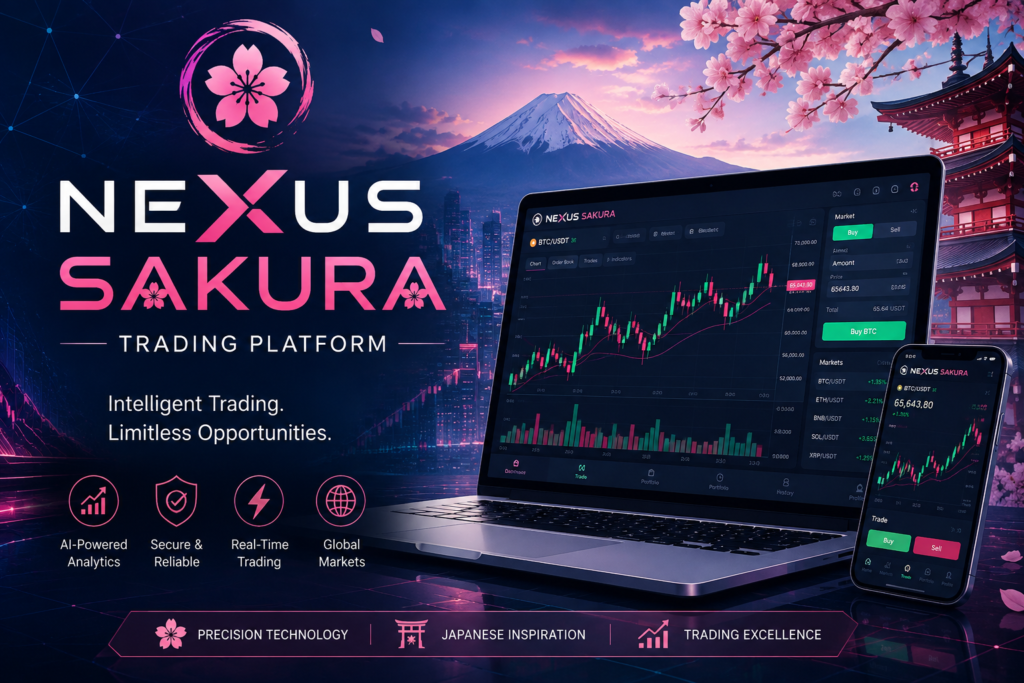
For years, retail traders and algorithmic enthusiasts have faced a frustrating divide. On one side, there are institutional-grade trading platforms—immensely powerful but locked behind complex coding requirements and archaic, cluttered interfaces. On the other side, there are consumer-grade mobile apps that look beautiful but lack the granular control required to run serious automated trading bots. Bridging this gap requires more than just a fresh coat of paint; it requires a fundamental rethinking of how human operators interact with artificial intelligence in fast-paced financial environments.
Nexus Sakura is not just another flashy broker. In fact, it operates strictly as a premium AI workflow engine and marketing platform—a digital command center designed to orchestrate automated trading bots, manage execution logic, and monitor activity through rigorously structured dashboards. It is built for a specific kind of user: the trader who understands that automation without readability is just a fast way to lose control. By prioritizing clarity, configurable safeguards, and a highly responsive visual aesthetic, Nexus Sakura is attempting to set a new standard for how we configure and monitor algorithmic trading.
The Philosophy Behind Nexus Sakura: Control Through Clarity
If there is a central thesis behind Nexus Sakura, it is that trading software should never obscure the reality of the market. High-frequency trading and AI-assisted automation can generate overwhelming amounts of data. When markets become volatile, a poorly designed dashboard can cause an operator to freeze or make panicked adjustments.
Nexus Sakura circumvents this by treating artificial intelligence not as a “magic black box” that prints money, but as a disciplined workflow engine. The platform relies on parameter-driven steps that coordinate analysis, execution, and monitoring views. Everything is broken down into structured controls and readable status states.
This approach emphasizes operational checkpoints. Rather than letting a bot run wild in the background, Nexus Sakura forces the user to establish explicit risk boundaries. It translates complex algorithmic actions into human-readable cards and status indicators. When the AI is analyzing markets, building a risk profile, or preparing an automation sequence, the user knows exactly what phase the system is in. The platform’s architecture is built to ensure that no automated action occurs without a clear, pre-configured policy routing it.
Quick Facts: Nexus Sakura Platform Overview
For a rapid breakdown of the platform’s technical specifications and core focus, refer to the facts table below:
| Feature Specification | Platform Details |
| Platform Name | Nexus Sakura |
| Core Functionality | AI-assisted trading bot workflow automation & monitoring |
| Operating Model | Marketing platform / UI interface (Not a direct brokerage) |
| Key AI Features | Process orchestration, policy routing, automated data scanning |
| Risk Management | Explicit parameter boundaries, layered risk checks, manual review checkpoints |
| Visual Architecture | Dark mode canvas, CSS/SVG animations, bounded data cards |
| Security & Privacy | Encrypted handling, secure session architecture, structured consent flows |
| Global Accessibility | Supports over 20 global languages with region-aware formatting |
| User Onboarding | 4-Step guided progression (Identity, Parameters, Risk, Monitoring) |
The Visual Identity: Premium Fintech Meets Cybernetic Design
You cannot discuss Nexus Sakura without addressing its striking visual interface. The platform utilizes a near-black canvas engineered to reduce eye strain during prolonged monitoring sessions. Cutting through this dark backdrop are precise accents of electric cyan and emerald glow, serving as immediate indicators of active systems and positive states. A single, distinct magenta-violet accent is reserved exclusively for primary actions, drawing the operator’s eye exactly where it needs to be when a decision is required.
But what truly sets the interface apart is the “discreet AI core” motif. The developers have integrated neural rings, orbiting particles, and a scanning beam into the background. Rather than distracting the user, these elements sit quietly behind the data, controlled by strict z-index layering. The motion relies purely on CSS/SVG transform-only animations, ensuring that the platform remains incredibly lightweight and fast. It respects reduced-motion preferences, meaning that if you prefer a static experience, the interface adapts without losing its premium feel.
The typography and layout are heavily optimized for internationalization. Nexus Sakura supports an impressive array of languages—from English and Deutsch to 日本語 (Japanese) and العربية (Arabic). To accommodate the varying text lengths of these languages, the UI relies on bounded cards with top-border accents and generous internal spacing. This ensures that a localized phrase does not break the layout, maintaining the platform’s clean readability whether you are monitoring from Tokyo, London, or New York.
Core Capabilities: The AI Automation Engine
Nexus Sakura organizes its AI-assisted bot workflows into six distinct modules. Each module is engineered for decisive execution and consistent review across all market conditions.
1. AI-Driven Process Orchestration
At the heart of the platform is the ability to define automation routines. Users can set parameter-driven steps that coordinate exactly how the AI analyzes the market, how it executes a trade, and how it reports that execution back to the user. The interface prioritizes clarity, keeping configurations highly readable so that you can trace the exact logic path your bot will take before deploying it.
2. Policy-Driven Routing
Nexus Sakura does not rely on hidden logic. Every action is routed through structured conditions and state transitions that preserve predictable behavior. Controls are presented as explicit options. If Market Condition A occurs, the system transitions to State B. This steady review mechanism allows traders to make micro-adjustments to their routing policies without having to rewrite underlying code.
3. Monitoring Dashboards
Tracking activity is handled via bounded dashboard panels. These cards summarize the performance context, current execution states, and operational metrics. Because the visual emphasis stays strictly within these cards, the overarching layout remains uncluttered. You can view your execution state (e.g., Active Review), your risk parameters, and the market context (e.g., Scanning) at a single glance.
4. Risk Controls as Parameters
Risk management is not an afterthought on Nexus Sakura; it is a foundational pillar. Risk controls are configured as explicit parameters and review checkpoints. The interface uses consistent labeling and status indicators to ensure that your downside protection is always active and clearly visible.
5. Operational Checklists
To ensure that operators do not miss crucial steps during setup, the platform utilizes structured checklists. This format allows for highly repeatable AI-assisted automation sessions. By forcing the user to verify each stage of the setup, the platform drastically reduces the chance of human error—a critical feature when deploying capital into live markets.
6. Privacy-Forward Handling
In an era where data security is paramount, Nexus Sakura integrates privacy directly into its workflow. The platform features structured consent flows that align perfectly with its policy pages. The design keeps essential privacy details visible and routes users through compliance checks smoothly, without aggressive pop-ups disrupting the experience.
The Console View: Analytics and Operational Indicators
When a bot session is active, Nexus Sakura presents its analytics in a highly polished console view. This console conveys operational indicators through smoothly animated, CSS-driven numbers that remain accessible across all devices, from massive desktop monitors to mobile screens.
Three primary metrics dominate this console:
- Model Cycles: Displayed as a pace indicator (e.g., cycles per minute), this metric shows how fast the AI is evaluating the market and iterating through its workflow. It gives the user a heartbeat of the automation process.
- Node Links: A compact view showing the active connected modules being used for automation routing. It tells you exactly how many logic branches are currently active and communicating with one another.
- Risk Checks: Displayed in layers, this shows the structured checkpoints the system is passing through. It provides peace of mind that the AI is continuously validating its actions against your predefined risk parameters.
The Nexus Sakura Registration Process: A Step-by-Step Guide
The onboarding process at Nexus Sakura is designed to be a guided progression. It eschews the chaotic, form-heavy sign-ups of legacy platforms in favor of a clean, four-step roadmap. This ensures that by the time you reach the main dashboard, your account is fully prepared for automation.
Step 1: Register and Verify Details
The journey begins by submitting basic contact information—First Name, Last Name, Email Address, and Phone Number. This initial form generates your account-ready profile. The platform uses region-aware defaults (automatically formatting your country code) and routes you through structured consent agreements for its Terms and Conditions, Privacy Policy, and Cookie Policy. It is a secure, identity-verified validation architecture.
Step 2: Configure Automation Parameters
Once inside, you do not immediately start trading. The next step is configuring your workflow settings. You will choose the bot parameters that govern how the AI-assisted engine coordinates its execution states. The controls are grouped logically, ensuring that you understand exactly what behavior you are programming into the system.
Step 3: Set Risk Boundaries
Before any session can be launched, Nexus Sakura requires you to apply risk parameters. You will input explicit values—such as drawdown limits or exposure caps—and establish review checkpoints. The platform will display status indicators confirming that your safeguards are securely in place. This step is non-negotiable and enforces disciplined configuration routines.
Step 4: Monitor and Review Sessions
The final step is transitioning into the active monitoring phase. You are given access to the dashboards that summarize your execution states and operational context. Here, you can watch the AI core status shift from “Analyzing markets” to “Building risk profile” and finally to “Preparing automation.” The visual layout keeps everything contained in cards, ensuring your workspace remains clean, legible, and ready for action.
Deep Dive: How Nexus Sakura Revolutionizes Risk Management
The downfall of many automated trading setups is the “set and forget” mentality. Operators build a bot, turn it on, and walk away, only to return to a liquidated account because market conditions shifted unexpectedly. Nexus Sakura actively fights against this by forcing structured oversight.
Parameter Boundaries
On this platform, risk is not a sliding scale hidden in a settings menu. Boundaries are configured as explicit, hard values that remain permanently visible on your main dashboard during both setup and active monitoring. You never have to click through multiple menus to remember what your stop-loss parameters are; they are right there, presented with clear labels and consistent spacing.
Review Checkpoints
Nexus Sakura introduces the concept of structured review checkpoints. These are mandatory moments built into the automation workflow where the system asks for confirmation of automation states. It acts as a digital safety net. If a bot detects a massive volatility spike, the workflow can be programmed to pause at a checkpoint, requiring the human operator to review the readable status items before authorizing the bot to continue.
Monitoring Visibility
True risk management requires immediate context. Nexus Sakura’s compact metrics and chart-style previews provide a macro view of the market’s behavior alongside a micro view of the bot’s execution state. If the data shifts rapidly, animated overlays update smoothly without breaking the readability of the text. You can see the exact moment a risk layer is triggered, allowing for swift, disciplined adjustments.
Who is Nexus Sakura Built For?
It is crucial to understand that Nexus Sakura operates exclusively as a marketing platform and workflow interface. It does not provide, endorse, or facilitate actual brokerage or investment services on its own; rather, it provides the technological architecture to manage them.
Therefore, the ideal user for Nexus Sakura is someone who already understands the fundamentals of algorithmic trading but is exhausted by terrible user interfaces. It is for the systems-thinker who wants to build automated routines but demands absolute clarity over how those routines execute. If you are a trader who relies on AI to scan markets but wants to maintain a firm grip on the steering wheel regarding risk boundaries and policy routing, Nexus Sakura is engineered specifically for your workflow.
Frequently Asked Questions (FAQs)
What is the core purpose of Nexus Sakura?
Nexus Sakura is designed to offer AI-assisted automation that organizes trading bot workflows, execution states, and monitoring views. Its primary purpose is to take the chaos out of algorithmic trading by emphasizing highly readable controls and consistent status indicators, allowing for disciplined, stress-free configuration.
How is Artificial Intelligence presented inside the interface?
Unlike platforms that treat AI as a hidden black box, Nexus Sakura treats AI as a transparent workflow engine. It coordinates parameters, evaluation cycles, and operational states right in front of you. The UI uses clear modules and compact cards so you can see exactly what the AI is thinking and doing during active monitoring.
How are risk controls represented on the platform?
Risk controls are expressed as explicit parameters, active checkpoints, and status labels that remain constantly visible during configuration and operation. This rigid structure supports consistent review routines and ensures you never lose sight of your operational boundaries.
What does the registration process actually enable?
Registering yields an account-ready profile. It connects your contact details to region-aware defaults, compliance policy routing, and your specific interface preferences. Completing the onboarding flow unlocks structured access to the automation configuration tools and the live monitoring dashboards.
How is the Nexus Sakura design optimized for readability?
The platform is meticulously designed to prevent visual overload. Decorative motion and cybernetic background elements are kept strictly behind the main content. All data is contained within bounded cards. The typography relies on strong hierarchy and generous spacing, ensuring that even when translated into longer languages, the interface remains perfectly legible on any screen size.
How does Nexus Sakura support ongoing, long-term monitoring?
Monitoring is delivered through a series of compact metrics (like Model Cycles and Node Links), session state updates, and clean chart-like previews contained within dashboard cards. This layout is optimized for rapid scanning, allowing operators to conduct reliable review checkpoints without getting lost in walls of raw data.
Final Verdict
The world of automated trading is fraught with platforms that overpromise and underdeliver, usually burying the user in a mess of poorly coded tools and confusing metrics. Nexus Sakura takes a refreshingly different route. By stripping away the clutter and focusing entirely on workflow clarity, structured risk boundaries, and a premium visual experience, it provides a highly professional environment for managing AI-driven trading bots.
It does not promise guaranteed riches—no honest software ever does. Instead, it promises control. Through its policy-driven routing, operational checklists, and discreet AI core, Nexus Sakura ensures that you are always the master of your automated strategies. If you are ready to bring discipline, deep analytics, and stunning design to your trading operations, Nexus Sakura is a platform well worth integrating into your daily workflow.