
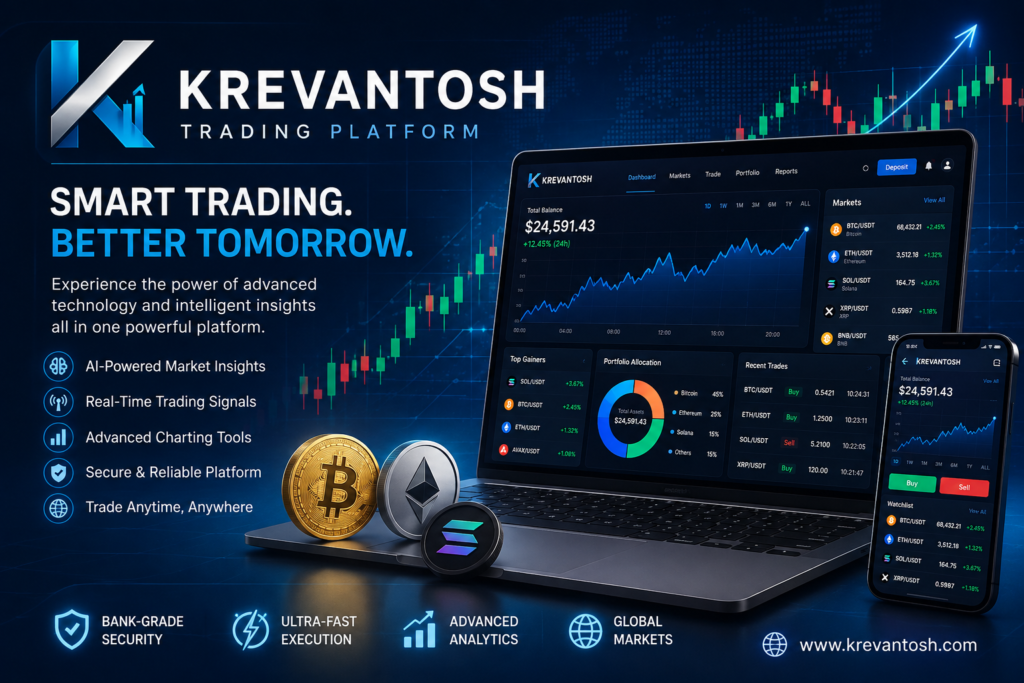
If you have spent any real time navigating the digital asset markets, you already know the brutal reality of retail trading. You build a solid thesis, wait for the perfect entry, and hit the buy button—only to be met with a frozen screen, a delayed fill, or a slippage margin that instantly eats your projected profit. The gap between institutional infrastructure and retail trading platforms has historically been a chasm. Retail gets the lag; institutions get the liquidity.
Enter the Krevantosh trading platform.
Over the past few months, Krevantosh has aggressively positioned itself as the corrective force to this industry-wide problem. Operating as a fully regulated, AI-driven investment platform, it promises sub-millisecond execution, tick-by-tick adaptive intelligence, and an institutional-grade security framework that frankly makes older legacy exchanges look negligent.
This isn’t just another platform promising “algorithmic magic.” It is a highly sophisticated, multi-layered trading engine built for people who treat risk management and execution speed as the foundation of profitability.
Below is a quick reference table of affiliate button text options optimized for high conversion. You can easily insert these throughout your campaign to capture intent at different stages of the reader’s journey.
The Core Philosophy: Execution is Everything
Before we get into the granular mechanics of the neural networks and language processing, we have to talk about latency. You can have the most accurate predictive model in the world, but if your platform takes 50 milliseconds to route your order, your model is useless. The market has already moved.
Krevantosh was engineered around a sub-2ms execution target. The platform treats execution quality not as an administrative afterthought, but as an integral part of the trading strategy.
When you place an order on Krevantosh, the execution dashboard separates every metric. It doesn’t just show you an “average fill time.” It breaks down market-data delay, decision time, network transit, venue acknowledgment, and final fill time. You get to see the percentile distributions (tracking median, p95, and p99 speeds separately). This means if you are experiencing slippage, you can immediately audit the trade to see if the issue was spread, delay, order size, or raw volatility.
This level of transparency is rare. Most platforms obscure their routing inefficiencies. Krevantosh highlights them, recalibrates, and uses smart routing to trim execution costs, constantly hunting for the exact moment liquidity is available.
Krevantosh Quick Facts Table
For a rapid overview of what Krevantosh brings to the table, here are the verified platform statistics and operational metrics.
| Feature / Metric | Specification |
| Global Reach | 120+ Supported Countries |
| Active User Base | 250,000+ Verified Accounts |
| Trading Volume | $4.2 Billion+ |
| Execution Speed | Sub-2ms Target Latency |
| Asset Security | 98.3% Cold Vault Storage |
| Protection Fund | $245 Million Dedicated Reserve |
| Encryption Standard | AES-256-GCM |
| Regulatory Alignment | SEC, FCA, CFTC, ASIC |
| System Uptime | 99.997% Availability |
| NLP Language Support | 35+ Languages Monitored Live |
| Technical Setups Mapped | 235+ Real-Time Patterns |
| Platform Certifications | ISO 27001, SOC 2 Type II, PCI DSS |
The Three-Tiered Trading Engine
A massive flaw in most algorithmic platforms is that they treat all timeframes equally. A signal that works for a 30-second scalp is completely irrelevant for a multi-week swing trade, yet many platforms blend these signals into a muddy, unusable proprietary “score.”
Krevantosh completely separates its architecture based on your holding period. It organizes your workflow into three distinct styles: Scalping, Day Trading, and Swing Trading.
1. Scalping: Ultra-Low Latency & Order-Book Intelligence
Scalping is a game of millimeters. It requires raw speed and a flawless read on the order book. When you set Krevantosh to scalp mode, it focuses entirely on normalized level-two data.
The engine monitors bid and ask depth, queue concentration, the width of the spread, cancellation velocity (how fast fake limit orders are pulled), and the replenishment rate of displayed liquidity. The system is smart enough to reject a trade if the expected slippage and latency fees outweigh the potential profit of the scalp. It actively filters out anomalous tick data and looks for repeatable order-book imbalances.
Furthermore, Krevantosh employs automatic circuit breakers. If the market data feed experiences timestamp drift or loses continuity for even a fraction of a second, the system suspends routing. You are never left trading blind on stale data.
2. Day Trading: Momentum and Multi-Timeframe Validation
For intraday trading, the focus shifts from micro-second order books to momentum and session structure. Krevantosh evaluates the rate of change, relative volume, volatility expansion, market breadth, and distance from the Volume-Weighted Average Price (VWAP).
But the real advantage here is the 3-Timeframe Confirmation protocol. The system refuses to interpret a random five-minute spike as a structural market shift. If a setup appears on the 5-minute chart, Krevantosh cross-verifies it against the 15-minute market structure and the 1-hour macro regime.
- Lower Timeframe: Dictates the exact entry timing.
- Middle Timeframe: Tests for trend continuity and volume confirmation.
- Higher Timeframe: Provides the broader context (resistance levels, realized volatility, trend direction).
If the timeframes conflict, the platform doesn’t just block the trade. It intelligently lowers the confidence score, tightens the assumed horizon, or dynamically reduces the recommended position size based on the increased risk.
3. Swing Trading: Macro Integration and On-Chain Analytics
When you step back to swing trade over days or weeks, technical analysis alone isn’t enough. You are fighting macroeconomic forces and blockchain-level liquidity shifts.
At this level, the Krevantosh engine pulls in a massive amount of external data. It evaluates exchange inflows and outflows, realized capitalization bands, and the cost basis of long-term holders. It tracks active network addresses and stablecoin issuance.
More importantly, it contextualizes crypto within traditional finance (TradFi). The platform monitors the DXY (US Dollar Index), 10-year Treasury yields, equity beta, and the VIX (volatility index). If Krevantosh detects a technical breakout on a crypto asset, but simultaneously sees the US Dollar strengthening and real yields spiking, the system will fundamentally downgrade the breakout’s confidence score, recognizing the hostile macro environment.
This culminates in Krevantosh’s “Phased Entry Protocol.” Instead of trying to catch the absolute bottom with a single massive order, the system advocates for structured allocation. Capital is deployed across initial confirmation, retest, continuation, and reserve phases. If the thesis weakens mid-trade, the reserve capital remains protected.
The Analytical Engine: Processing the Unstructured Market
One of the most impressive feats of the Krevantosh trading platform is how it digests unstructured data—news, social sentiment, and macro announcements—and turns it into executable intelligence.
Multilingual NLP (Natural Language Processing)
The financial markets are global, yet most retail traders only react to English-language news. Krevantosh monitors financial news, corporate disclosures, and governance announcements across 35+ languages simultaneously.
The language engine doesn’t just look for keywords; it measures sentiment tone, urgency markers, and narrative shifts. Because it processes information natively across dozens of languages, it can catch a regulatory shift in Asia or a central bank pivot in Europe long before the syndicated English headlines are published. The system actively clusters duplicate news to prevent “syndication noise” from faking a consensus, and it filters out bot-driven social media hype.
Neural Pattern Recognition
Chart reading is inherently subjective when done by humans. You see a bull flag; another trader sees a rising wedge. Krevantosh removes the bias.
The platform’s neural pattern library continuously scans for over 155 validated technical setups (with some modules detecting up to 235 micro-structures). It trained on over eight years of tick-level historical data. When it spots a pattern—whether it’s an ascending triangle, a complex Fibonacci retracement, or a volume-profile migration—it scores that setup against historical win rates.
Every detected pattern requires multi-indicator consensus. A breakout must be confirmed by momentum, volatility, and volume. If a pattern lacks statistical edge or volume confirmation, it is discarded before it ever reaches your dashboard.
Institutional-Grade Security & Regulation
In 2026, a trading platform’s security architecture is vastly more important than its trading features. The graveyard of hacked exchanges is overflowing. Krevantosh has approached asset security with extreme paranoia, building an environment that mirrors institutional banking standards.
Multi-Layered Defense Architecture
- 98.3% Cold Vault Storage: Krevantosh keeps 98.3% of all client capital entirely offline. These assets sit in physically isolated, network-free vaults that are mathematically impossible to reach via remote intrusion.
- AES-256-GCM Encryption: Every single transaction and data packet is wrapped in AES-256-GCM encryption. This is the gold standard for secure data transmission, ensuring that your trading activity remains completely invisible to outside threats and man-in-the-middle attacks.
- D-MFA and Biometric Checks: Perimeter access is ruthlessly guarded. The platform utilizes Dynamic Multi-Factor Authentication (D-MFA) combined with biometric identity checks and behavioral pattern analysis. If a login attempt deviates from your standard behavioral fingerprint, the system locks it down.
- Automated Threat Containment: The platform features automated containment protocols that execute the instant an anomaly is detected, updating the defensive posture without dragging down the platform’s execution speed.
The $245 Million Reserve Fund
Black swan events happen. Liquidity dries up, flash crashes occur, and unexpected shocks rattle the market. To ensure absolute solvency and client protection, Krevantosh maintains a dedicated Asset Resilience Reserve of over $245 million. This standing capital ensures that trader withdrawals and operational liquidity never falter, regardless of broader market contagion.
Regulatory Compliance & Auditing
Krevantosh is not a shadow entity operating out of an unregulated jurisdiction. It operates under full licensing and strict operational oversight. It aligns with the standards set by top-tier financial watchdogs, including:
- SEC (U.S. Securities and Exchange Commission)
- FCA (Financial Conduct Authority – UK)
- CFTC (Commodity Futures Trading Commission)
- ASIC (Australian Securities and Investments Commission)
Furthermore, the platform holds global certifications for data privacy and operational security, including ISO 27001, PCI DSS, and SOC 2 Type II. To maintain these standards, independent cybersecurity teams run demanding stress tests on the entire platform stack every fourteen days.
The Krevantosh Registration Process: Step-by-Step
Because Krevantosh operates under strict regulatory oversight (KYC and AML compliance), the onboarding process is more rigorous than that of decentralized exchanges, but it is highly optimized. You can generally move from registration to live trading in under 15 minutes.
Step 1: Account Initialization
Navigate to the official Krevantosh website and initiate the sign-up process. You will need to provide your primary email address, a secure password, and your country of residence (the platform supports users across 120+ countries).
Step 2: Identity Verification (KYC)
To comply with global regulators like the FCA and SEC, Krevantosh requires standard identity verification. You will be prompted to upload a government-issued ID (passport or driver’s license) and complete a quick biometric facial scan using your webcam or smartphone. Because the platform uses automated compliance architecture, verification typically clears in a matter of minutes, not days.
Step 3: Security Setup (D-MFA)
Before you are allowed to fund your account, you must secure it. You will configure the Dynamic Multi-Factor Authentication. This usually involves linking an authenticator app (like Google Authenticator or Authy) and configuring biometric approvals if you are using a mobile device.
Step 4: Funding the Account
Once verified, you can access the deposit gateway. Krevantosh supports a wide variety of funding methods, including direct bank transfers, credit/debit facilities, and direct crypto deposits. Thanks to the integrated liquidity providers, fiat deposits are reflected rapidly.
Step 5: Dashboard Configuration & Risk Profiling
Upon your first login, the platform will prompt you to set your base risk parameters. You will define your primary trading style (Scalp, Day, Swing), your maximum acceptable daily drawdown, and your baseline asset exposure limits. The engine uses these parameters to calibrate the signals and alerts it sends to your dashboard.
Frequently Asked Questions (FAQ)
To clear up any lingering ambiguities, we’ve expanded on the most common questions traders have before migrating their capital to Krevantosh.
1. What is actually happening under Krevantosh’s hood?
At its core, Krevantosh runs a continuous, non-stop loop of market analysis. It reads live data, weighs probability options using its neural networks, applies your personal risk limits, and manages the execution. It continuously cross-references technical chart data, fundamental news sentiment, and macroeconomic indicators to generate high-probability trade setups without emotional bias.
2. How is this different from a typical retail crypto exchange?
Standard exchanges are passive order-matching engines; they simply facilitate your trades and take a fee, leaving all the analytical heavy lifting to you. Krevantosh is an active intelligence platform. It provides institutional-grade analytics, sub-2ms smart routing to prevent slippage, and active risk management tools (like volatility-adjusted sizing) built directly into the interface.
3. How are funds and personal data kept safe here?
Security is handled at a foundational level. 98.3% of client capital is kept entirely offline in cold vault architecture, meaning it cannot be hacked remotely. Your personal data and all trading activities are secured via AES-256-GCM encryption, and the platform utilizes D-MFA and biometric locks to prevent unauthorized account access. Furthermore, a $245M protection fund acts as a final safety net.
4. Does this work for someone who has never touched crypto before?
Yes, but with a caveat. While Krevantosh is incredibly intuitive and automates complex data analysis, trading inherently carries risk. The platform is designed to make professional-level data easy to understand, but absolute beginners should start slowly, utilize the risk-management rails (like maximum drawdown stops), and focus on swing-trading setups rather than hyper-fast scalping until they understand market dynamics.
5. What trading styles and timeframes are supported?
Krevantosh is completely modular. It supports ultra-low latency scalping (tracking order book imbalance), intraday trading (using multi-timeframe validation and momentum signals), and long-term swing trading (integrating on-chain analytics and macro-economic tracking). The interface adapts to the timeframe you select.
6. What performance data and analytics do users actually get?
You receive total transparency. Instead of vague buy/sell signals, Krevantosh shows you its work. You can view order-book imbalances, latency percentiles, volume-profile levels, exchange inflows, and neural network confidence scores. Every signal is accompanied by the exact data points that generated it.
Final Verdict: Is Krevantosh Worth the Migration?
The financial trading software market is flooded with platforms that over-promise and brutally under-deliver. They plaster “AI” on their homepage, slap a moving average on a chart, and charge premium fees.
Krevantosh is genuinely different. It was clearly designed by people who understand market microstructure, order-book dynamics, and the devastating impact of latency and slippage. By separating the analytical engine into three distinct timeframes, heavily integrating macroeconomic data, and backing it all up with a 98.3% cold storage mandate and a $245M reserve, Krevantosh has built a fortress for active traders.
If you are tired of trading against institutional algorithms with subpar retail tools, blind spots in your macro thesis, and execution delays that steal your margins, Krevantosh is the necessary upgrade. It demands a professional mindset, but for traders willing to leverage its full architectural power, it offers a definitive edge in the 2026 market landscape.