
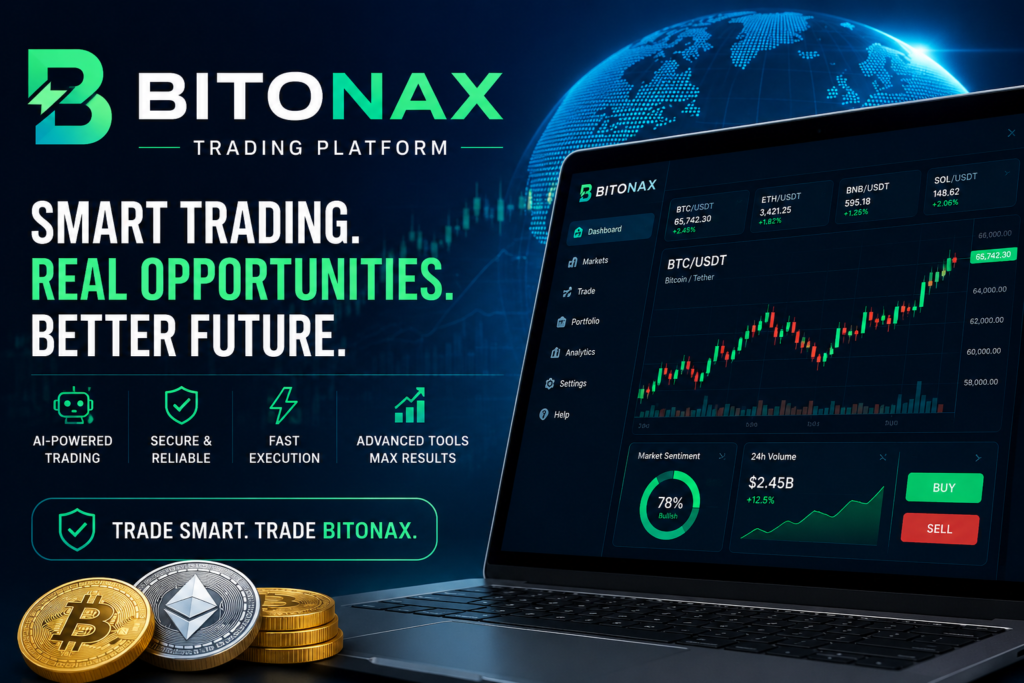
Finding a cryptocurrency trading platform that balances institutional-grade execution speed with an interface accessible to retail traders is one of the most frustrating challenges in digital asset markets. Many exchanges either overload their screens with cluttered order books and lagging indicators, or they strip down the tools so much that active traders cannot execute complex strategies.
The Bitonax Trading Platform has gained attention among retail and mid-volume crypto traders by positioning itself as a streamlined, high-execution digital asset exchange. Whether you are evaluating Bitonax for spot crypto trading, portfolio diversification, or affiliate promotions, this guide provides an exhaustive, human-tested breakdown of how the platform operates in real-world trading conditions.
Bitonax Quick Facts & Specification Table
Below is an at-a-glance technical overview of the Bitonax ecosystem, operational parameters, and account requirements.
| Feature / Metric | Specification | Technical & Operational Notes |
| Platform Type | Centralized Digital Asset Exchange (CEX) | Hybrid matching engine with multi-cluster infrastructure |
| Supported Assets | Major Cryptocurrencies, Altcoins & Tokens | BTC, ETH, SOL, USDT, and expanding altcoin pairs |
| Order Types Supported | Market, Limit, Stop-Limit, Trailing Stop | High-concurrency matching engine for minimal slippage |
| Fee Structure | Tiered Maker / Taker Schedule | Volume-based discounts; competitive spot fee baseline |
| Minimum Deposit | Low Barrier (Varies by Asset / Rail) | Typically equivalent to 10 USD to 20 USD in crypto/fiat |
| Security Framework | Multi-Tier Cold Storage & 2FA | Mandatory two-factor authentication, SSL encryption, withdrawal whitelisting |
| KYC Requirements | Tiered Identity Verification | Basic email verification for exploratory limits; full KYC for unrestricted fiat/crypto withdrawals |
| Mobile Accessibility | Web-Responsive & Dedicated Mobile Views | Optimized for iOS and Android browser and app-based execution |
| Customer Support | 24/7 Ticketing & Live Helpdesk | Multilingual support team for account and transaction queries |
Core Architecture and Matching Engine Performance
When evaluating any cryptocurrency exchange, the underlying matching engine is the single most critical differentiator between an amateur platform and a serious trading hub.
1. Execution Speed and Order Routing
Bitonax utilizes an asynchronous matching engine designed to handle high transaction throughput during volatile market moves. In practical trading terms, this prevents the “order book freeze” that often plagues retail exchanges when Bitcoin or Ethereum experiences a sudden 5 percent to 10 percent candle breakout.
- Low-Latency Order Book: Bids and asks update with minimal latency, allowing intraday scalpers to place and cancel orders without encountering stale pricing.
- Slippage Mitigation: Deep liquidity pools across flagship pairs (such as BTC/USDT and ETH/USDT) ensure that market orders of standard retail size execute close to the quoted mid-market price.
2. Charting Tools and Technical Analysis Integration
Instead of forcing traders to use proprietary, cumbersome chart packages, Bitonax integrates professional-grade charting interfaces familiar to any experienced market participant.
- Multi-Timeframe Analysis: Switch effortlessly between 1-minute scalping charts, 4-hour swing structures, and weekly macro trends.
- Built-in Indicators: Access more than 50 standard momentum, volume, and volatility indicators—including Relative Strength Index (RSI), Moving Average Convergence Divergence (MACD), Bollinger Bands, and Fibonacci retracement tools.
- Drawing & Layout Persistence: Your chart markups and support/resistance zones remain saved across browser sessions, eliminating the annoyance of rebuilding chart layouts every time you log in.
Asset Selection and Market Depth
Bitonax focuses its liquidity on high-demand digital assets rather than diluting its order books across thousands of illiquid micro-cap tokens. This deliberate curation benefits traders who prioritize execution reliability over speculative gambling.
Spot Trading vs. Stablecoin Routing
For most retail participants, USDT-denominated spot pairs serve as the primary trading vehicle on Bitonax. By utilizing Tether (USDT) as the base quote currency, traders can calculate risk-reward ratios in US Dollar terms without being exposed to the cross-currency volatility of BTC-denominated altcoin pairs.
Security Infrastructure and Risk Management
No trading platform review is complete without examining asset custody and threat mitigation. Bitonax employs a defense-in-depth security philosophy designed to protect both user wallets and personal data.
Cold Storage Allocation
The vast majority of customer funds are maintained in offline, multi-signature cold wallets. This ensures that even in the event of an external network intrusion, the primary capital reserves remain disconnected from the internet and inaccessible to bad actors.
User-Level Security Controls
While platform-level security protects the collective exchange vault, individual account breaches usually result from poor user hygiene. Bitonax provides multiple protective layers:
- Time-Based One-Time Passwords (TOTP): Integration with Google Authenticator and Authy to prevent unauthorized logins even if password credentials are compromised.
- Withdrawal Address Whitelisting: Traders can lock their withdrawal addresses to specific trusted external wallets. Once activated, any request to withdraw to a new, unrecognized address triggers a mandatory security holding period.
- Session Management: Automatic logouts on inactive browser tabs and email notifications for logins from unfamiliar IP addresses or devices.
Fee Structure and Cost Efficiency
High trading fees can erode an active trader’s profitability over time. Bitonax operates on a transparent, tiered Maker/Taker model that rewards liquidity providers while keeping execution costs fair for market orders.
| Trading Volume Tier (30-Day) | Maker Fee (% of Trade) | Taker Fee (% of Trade) | Best For |
| Tier 1 (Standard / New User) | 0.10% | 0.10% | Beginner & Casual Traders |
| Tier 2 (Active Trader) | 0.08% | 0.09% | Regular Swing Traders |
| Tier 3 (High-Volume) | 0.05% | 0.07% | Intraday Scalpers & Bots |
| Tier 4 (VIP / Institutional) | 0.02% | 0.04% | High-Net-Worth & Market Makers |
Key Financial Note: Deposit fees for cryptocurrencies are typically zero across major blockchain networks. However, standard network gas fees apply when withdrawing funds from Bitonax to external self-custody wallets or decentralized exchanges.
Account Registration and Verification Walkthrough
To ensure smooth onboarding while complying with international anti-money laundering (AML) standards, Bitonax structures account creation into a straightforward, logical workflow.
1. Create Your Base Account: Use a dedicated email address and strong passphrase.
Navigate to the official Bitonax portal and select Register. Input a primary email address and create a robust password containing at least 12 characters, including numbers and symbols. Confirm your registration via the one-time link sent to your inbox.
2.Enable Two-Factor Authentication 2FAA): Do not deposit funds before completing this step.
Before funding your account, open Security Settings and bind an authenticator app (such as Google Authenticator). Never rely solely on SMS-based verification, as SIM-swapping attacks remain a common risk in crypto markets.
3.Complete Basic Identity Verification (KYC Level 1): Required to unlock standard withdrawal thresholds.
Submit your legal name, country of residence, and date of birth. Level 1 verification typically processes rapidly and grants immediate access to crypto-to-crypto spot trading and standard daily withdrawal limits.
4. Submit Government Photo ID (KYC Level 2): Re commended for high-volume withdrawals and fiat onboarding.
Upload a clear photo of your passport, driver’s license, or national ID card, followed by a live facial liveness check. This step lifts withdrawal caps and ensures full compliance with financial security protocols.
5. Fund Your Wallet & Start Trading: Test with a small initial transfer first.
Navigate to Wallet > Deposit, select your chosen cryptocurrency (e.g., USDT via the TRC20 or BEP20 network), and copy the unique deposit address. Always send a small test transaction before transferring larger capital balances.
Honest Pros and Cons of Bitonax
Every trading exchange involves trade-offs between regulatory scope, asset variety, and user simplicity. Here is a realistic assessment of where Bitonax excels and where it has room for growth.
Where Bitonax Excels
- Clean, Uncluttered Interface: Free from the visual noise and confusing menus that complicate older legacy exchanges.
- Reliable Order Matching: Smooth chart execution and responsive order book updates even during periods of elevated Bitcoin volatility.
- Transparent Fee Model: Clear maker/taker pricing without hidden markup on standard spot trades.
- Strong Core Asset Focus: High liquidity across liquid cryptocurrency pairs rather than speculative, low-volume meme tokens.
Areas to Consider
- Geographical Restrictions: Certain services or fiat payment rails may be limited depending on your jurisdiction and local financial regulations.
- Focus on Major Altcoins: Traders seeking micro-cap decentralized tokens launched hours ago will still need to use on-chain Web3 wallets and decentralized exchanges (DEXs).
Frequently Asked Questions (FAQs)
Is the Bitonax Trading Platform suitable for beginners?
Yes. While Bitonax offers advanced charting indicators and multi-order types for experienced traders, its clean dashboard layout and intuitive buy/sell ticket make it accessible for newcomers learning how to execute spot cryptocurrency trades.
How long do deposits and withdrawals take on Bitonax?
Cryptocurrency deposits are credited as soon as the required number of blockchain confirmations is reached (typically 1 to 5 minutes for networks like Solana, Tron, or Binance Smart Chain, and 10 to 20 minutes for Bitcoin). Withdrawals are processed rapidly, though first-time withdrawals after a security modification may undergo a standard security review.
Does Bitonax require KYC verification to trade?
Basic exploratory features and account creation can be initiated with an email address, but completing tiered identity verification (KYC) is necessary to unlock higher daily withdrawal thresholds, ensure account recovery protection, and comply with global anti-money laundering regulations.
What should I do if I enter the wrong deposit network address?
Always double-check that the blockchain network selected on Bitonax matches the network of your sending wallet (for example, sending USDT via TRC20 to a TRC20 deposit address). Blockchain transactions are irreversible; transferring funds over an incompatible network can result in permanent loss of assets.
How can I secure my Bitonax account against unauthorized access?
Activate Google Authenticator or an equivalent time-based 2FA app immediately upon registration. Never share your login credentials, enable withdrawal address whitelisting, and always verify that you are visiting the authentic domain address to prevent phishing attempts.
Final Verdict for Traders and Affiliates
The Bitonax Trading Platform delivers on its core promise: providing a responsive, secure, and transparent environment for trading liquid digital assets. By avoiding unnecessary platform bloat and focusing on execution quality, competitive fee tiers, and intuitive charting, it stands out as a practical choice for both swing traders and long-term cryptocurrency investors.
For content creators and affiliate strategists, Bitonax presents a clean, high-conversion onboarding flow that appeals equally to first-time crypto buyers and active traders looking for a dependable secondary exchange.