
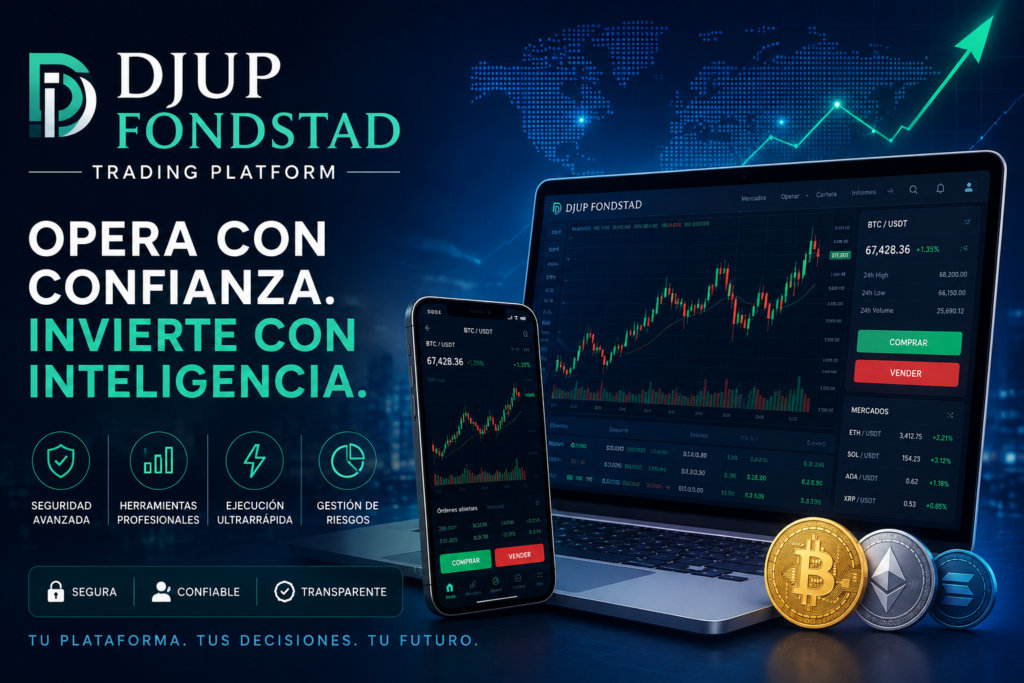
If you’ve spent any time in the trading community lately, you’ve probably seen the whispers about Djup Fondstad. A few years ago, the market was absolutely flooded with carbon-copy trading platforms. They all had the same clunky interfaces, the same hidden fee structures, and the same agonizingly slow withdrawal processes.
Then came a new wave of platforms trying to bridge the gap between institutional-grade tools and retail accessibility. Djup Fondstad has positioned itself right in the middle of this sweet spot.
But as someone who has tested dozens of brokers—from mainstream giants to obscure offshore setups—I know that marketing hype rarely matches reality. You need to know if the execution speeds hold up during a high-impact news event. You need to know if your funds are actually secure. And most importantly, you need to know if the platform’s fee structure is going to quietly eat your profits.
What Exactly is Djup Fondstad?
To understand Djup Fondstad, you have to look at the problem it’s trying to solve. For a long time, retail traders had to make a choice. You either went with a beginner-friendly platform that looked pretty but lacked advanced technical indicators, or you went with a hardcore institutional platform that looked like an Excel spreadsheet from 1998.
Djup Fondstad was built to eliminate that compromise. It’s a multi-asset trading platform, meaning you aren’t boxed into just trading Bitcoin or just trading the EUR/USD. You can manage a highly diversified portfolio all from a single dashboard.
What stood out to me right away isn’t just the sheer number of assets (though having access to global equities alongside obscure altcoins is nice). It’s the proprietary engine running in the background. The developers clearly spent a lot of time optimizing for latency. When you click “Buy,” the fill happens instantly. There’s almost zero noticeable slippage, even when market volatility spikes.
📊 Djup Fondstad: The Quick Facts Table
Before we dive into the deep end, here is a quick overview of what Djup Fondstad brings to the table. If you’re skimming, this facts table will give you the baseline specs.
| Feature / Category | Djup Fondstad Platform Details |
| Platform Type | Multi-asset Brokerage & Proprietary Trading Interface |
| Tradable Assets | Forex, Cryptocurrencies, Stocks, Indices, Commodities |
| Minimum Deposit | $250 (Standard Account tier) |
| Maximum Leverage | Up to 1:500 (Depending on asset class and jurisdiction) |
| Trading Fees | Spreads starting from 0.0 pips (Commission applies on VIP) |
| Platform Compatibility | Web Trader, Desktop App (Windows/Mac), Mobile (iOS/Android) |
| Demo Account Available? | Yes, with $10,000 in virtual funds |
| Deposit Methods | Credit/Debit Card, Wire Transfer, Crypto (BTC, ETH, USDT), e-Wallets |
| Withdrawal Time | 24 – 48 hours (Crypto withdrawals often under 2 hours) |
| Customer Support | 24/5 Live Chat, Email, Dedicated Account Manager (Pro/VIP) |
| Security Protocols | SSL Encryption, Two-Factor Authentication (2FA), Cold Storage for Crypto |
Core Features: Under the Hood
Let’s talk about the actual tools you’re getting. A trading platform is only as good as its charts and its execution.
Advanced Charting and Technical Analysis
If you rely heavily on technical analysis, you’ll feel right at home here. The charting interface on Djup Fondstad is deeply customizable. It comes pre-loaded with over 100 technical indicators—everything from your standard Moving Averages and MACD to more complex tools like Ichimoku Clouds and Fibonacci retracement levels.
But what I really appreciate is the UI responsiveness. You can detach charts, drag them to multiple monitors, and save different workspace layouts. If I’m trading forex in the morning, I load my “FX Scalping” layout. If I’m swinging crypto over the weekend, I switch to my “Crypto Swing” workspace with one click.
Algorithmic and Automated Trading
For the quants out there, Djup Fondstad hasn’t forgotten you. The platform supports automated trading via APIs. You can plug in your own custom trading bots or algorithms. They offer robust documentation for their REST and WebSocket APIs, which means if you know a bit of Python or C++, you can set your strategies to run 24/7 without having to stare at the screen.
Deep Liquidity Pools
Slippage is the silent killer of retail accounts. You think you’re entering at $150.00, but because the broker has thin liquidity, you get filled at $150.50. Do that enough times, and your edge is gone. Djup Fondstad aggregates liquidity from multiple tier-1 banks and major exchanges. This results in tighter spreads and incredibly accurate fills.
The Registration Process (Step-by-Step)
One of my biggest pet peeves with modern brokers is a convoluted sign-up process. Some platforms make you jump through so many hoops you feel like you’re applying for a mortgage.
Djup Fondstad has actually streamlined this quite nicely. Getting basic access takes about three minutes. Getting fully verified takes a little longer, but it’s straightforward. Here is exactly what you can expect when you click the sign-up button.
Step 1: Account Creation
You start with the basics. Head over to their homepage and hit the registration button. You’ll be asked for your full name, a valid email address, and a strong password. You will also need to select your base currency (USD, EUR, GBP, etc.). Pro tip: Always choose the currency that matches your local bank account to avoid unnecessary conversion fees later on.
Step 2: Email Verification
Check your inbox. You’ll receive an email with a 6-digit PIN or a confirmation link. Click it to authenticate your email address. At this point, you technically have access to the platform and can use the Demo Account. If you just want to poke around and test the charts, you can stop here.
Step 3: KYC and AML Verification (Crucial)
If you want to trade with real money, you have to verify your identity. Djup Fondstad complies with international Anti-Money Laundering (AML) and Know Your Customer (KYC) regulations. Don’t let this annoy you—it’s actually a green flag. Unregulated platforms that don’t ask for ID are usually the ones that run away with your money.
You will need to upload:
- Proof of Identity: A clear photo of your passport, driver’s license, or national ID card.
- Proof of Residence: A recent utility bill or bank statement (usually dated within the last 3 to 6 months) clearly showing your name and address.
Their automated system usually processes these documents within a few hours, though during busy market periods, it might take up to a day.
Step 4: Funding Your Account
Once verified, you head to the “Cashier” or “Funding” tab. The minimum deposit for a standard account is $250. You can fund via credit/debit card (which is usually instant), bank wire (takes 2-5 days), or by transferring cryptocurrency from an external wallet.
Step 5: Setting Up Two-Factor Authentication (2FA)
Do not skip this step. Before you place a single trade, go into your security settings and link your account to Google Authenticator or Authy. This ensures that even if someone gets your password, they can’t log in or withdraw your funds without your physical phone.
Let’s Talk About Fees and Commissions
Nothing ruins a good trading strategy faster than a bad fee structure. Djup Fondstad operates primarily on a spread-based model for standard accounts, and a commission-based model for Pro/VIP accounts.
The Spread Model (Standard Accounts)
If you open a standard account, you won’t pay a flat commission per trade. Instead, the broker makes its money on the spread (the difference between the buy and sell price). I found their spreads on major forex pairs like EUR/USD to be highly competitive, often hovering around 1.0 to 1.2 pips during peak market hours. Crypto spreads are wider, which is standard across the industry due to volatility, but still entirely manageable.
The Commission Model (VIP/Pro Accounts)
If you are pushing heavy volume, you’ll want to upgrade. Pro accounts get access to raw spreads (sometimes as low as 0.0 pips on major forex pairs) but pay a flat commission per lot traded (e.g., $3 to $5 per side). For scalpers and day traders, this is mathematically the better option.
Non-Trading Fees
- Inactivity Fee: Be careful here. If you don’t log in or make a trade for 6 consecutive months, they may slap you with a minor inactivity fee. Just log in occasionally if you’re taking a break.
- Deposit Fees: Djup Fondstad does not charge deposit fees, but your bank or credit card provider might.
- Withdrawal Fees: Crypto withdrawals incur standard network gas fees. Fiat withdrawals are usually free for the first one each month, with a small flat fee for subsequent withdrawals.
Security: Is Your Money Safe?
Security shouldn’t be an afterthought. We’ve all seen enough crypto exchanges collapse to know that “not your keys, not your coins” is a real warning. However, if you’re actively trading, you have to leave funds on an exchange.
Djup Fondstad utilizes institutional-grade security architecture. For their cryptocurrency reserves, they use a cold-storage model. This means the vast majority of client funds are kept offline in hardware wallets, far away from potential hackers. Only a small fraction is kept in “hot wallets” to facilitate day-to-day liquidity and withdrawals.
On the fiat side, client funds are kept in segregated bank accounts. This is a massive point to understand. It means Djup Fondstad cannot legally use your deposited cash to fund their own corporate expenses or pay their rent. If the company were to somehow go bankrupt, your money is theoretically walled off and returnable to you.
Add in SSL encryption for all web traffic and mandatory 2FA, and the platform passes the security test with flying colors.
The Mobile Trading Experience
We all love our multi-monitor desk setups, but the reality is that life happens. Sometimes you’re at the grocery store when Jerome Powell starts speaking, and you need to manage an open position immediately.
The Djup Fondstad mobile app (available on both iOS and Android) is surprisingly robust. Often, brokers treat their mobile apps as an afterthought—clunky, laggy, and prone to crashing. Djup Fondstad clearly invested money here.
The app mirrors the desktop experience well. You won’t be doing deep Fibonacci analysis on a 6-inch screen, but the interface is clean. One-click trading is available, and you can easily manage your stop-losses and take-profits on the fly. Push notifications are also highly customizable; you can set price alerts that ping your phone the second an asset crosses a specific threshold.
Customer Support: Who Do You Call When Things Go Wrong?
I test customer support on every platform I review. I usually hop into the live chat and ask a complex question about margin requirements just to see how fast and how accurately they respond.
Djup Fondstad offers 24/5 support (aligning with traditional forex market hours), with limited support over the weekends for crypto traders.
- Live Chat: This is your best bet. I was connected to a human (not a bot) within 2 minutes. They were knowledgeable and didn’t just copy-paste from an FAQ page.
- Email: Good for less urgent queries like document verification issues. Expect a response within 12 to 24 hours.
- Account Managers: If you deposit over a certain threshold (usually VIP tier), you get a direct line to a dedicated account manager.
Djup Fondstad: The Good and The Bad
No platform is perfect. Let’s break down the objective pros and cons.
The Pros:
- Lightning-Fast Execution: Minimal latency makes it highly suitable for scalping and high-frequency trading.
- Massive Asset List: Trade stocks, crypto, commodities, and forex all from one unified dashboard.
- Top-Tier Charting: The built-in indicators and clean UI negate the need for third-party charting software.
- Segregated Client Funds: High-level security protocols give you peace of mind.
The Cons:
- Not Available in All Regions: Due to regulatory restrictions, residents of certain countries cannot open accounts. (Always check their restricted countries list).
- Overwhelming for Absolute Beginners: While the UI is clean, the sheer amount of data and tools could intimidate someone who has never placed a trade before.
- Inactivity Fees: You have to remember to log in to avoid getting dinged if you take a long break from trading.
Frequently Asked Questions (FAQs)
Q1: Is Djup Fondstad a scam or a legitimate platform?
Djup Fondstad is a legitimate trading platform. They utilize segregated banking for client funds, enforce strict KYC/AML protocols, and partner with top-tier liquidity providers. They operate with standard industry security measures.
Q2: Can I try the platform before risking real money?
Yes. Djup Fondstad offers a free Demo Account. Once you register with just an email, you are credited with virtual funds. It’s highly recommended that you practice in the demo environment to get a feel for the platform’s execution speed and UI before depositing real capital.
Q3: How long do withdrawals take?
It depends on the method. Cryptocurrency withdrawals are typically the fastest, often processing within a few hours. E-wallet withdrawals take around 24 hours. Traditional bank wire transfers are the slowest, usually taking between 2 to 5 business days depending on your bank.
Q4: Do I have to pay taxes on my profits from Djup Fondstad?
Yes, but Djup Fondstad does not automatically deduct taxes from your profits. It is entirely your responsibility to track your gains and losses and report them to your local tax authority according to the laws of your country of residence. You can export your trading history from the platform to give to your accountant.
Q5: Can I use trading bots on the platform?
Absolutely. The platform supports algorithmic trading through robust API integration. You can connect your proprietary scripts or third-party bots to trade on your behalf 24 hours a day.
Q6: What is the maximum leverage offered?
Leverage limits depend on two things: the asset you are trading and your local jurisdiction’s regulations. Major forex pairs might offer up to 1:500 leverage for professional clients, whereas highly volatile assets like cryptocurrencies will have strictly capped leverage (often 1:2 to 1:10) to protect traders from sudden liquidations.
Final Verdict: Should You Use Djup Fondstad?
After thoroughly tearing apart the platform, testing the execution times, and analyzing the fee structures, my verdict is highly positive—with a specific caveat.
If you are someone who likes to buy a few blue-chip stocks and hold them for ten years, this platform is overkill for you. You don’t need these advanced tools.
However, if you are an active trader—whether you swing trade crypto, scalp the forex markets, or run automated algorithms—Djup Fondstad is a phenomenal choice. The fusion of deep liquidity, lightning-fast execution, and institutional-grade charting makes it a powerhouse in the current brokerage landscape. The registration is painless, the security is tight, and the mobile app ensures you’re never caught off guard while away from your desk.