
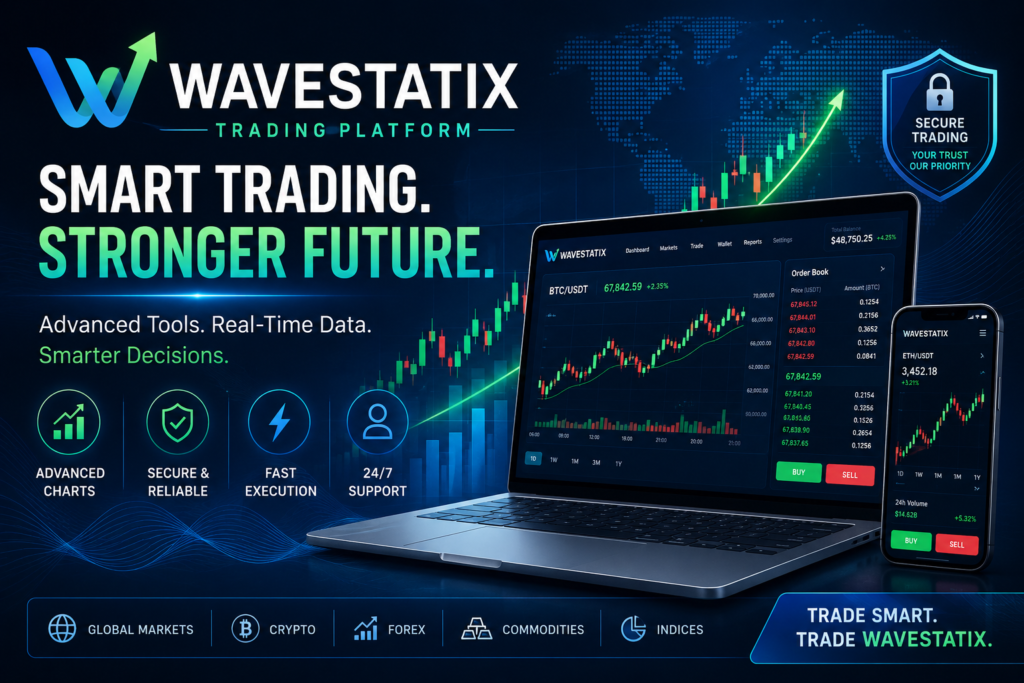
The digital trading landscape has evolved dramatically, and as we navigate through 2026, the demand for platforms that bridge the gap between high-frequency retail trading and enterprise-grade blockchain infrastructure has never been higher. Enter the Wavestatix Trading Platform —a comprehensive digital ecosystem that isn’t just about buying and selling digital assets, but about providing a robust, secure, and highly analytical environment for modern traders, developers, and institutions alike.
In this exhaustive review and guide, we will break down everything you need to know about Wavestatix in 2026. From its advanced smart contract auditing features and DevOps integrations to market analytics, supply chain ledger pilots, and the user registration process, this article serves as your ultimate index for mastering the Wavestatix ecosystem.
What is the Wavestatix Trading Platform?
Wavestatix is a next-generation trading and blockchain software management interface. Unlike traditional cryptocurrency exchanges that focus purely on spot and futures trading, Wavestatix positions itself as a holistic infrastructure hub. It is designed for traders who need deep market data, enterprise logistics teams testing distributed ledger technology (DLT), and developers who require seamless CI/CD (Continuous Integration and Continuous Deployment) monitoring.
Wavestatix Facts & Specifications Table
For a quick overview of what the platform offers, refer to this comprehensive facts table:
| Feature/Specification | Details |
| Platform Name | Wavestatix Trading Platform |
| Current Edition | 2026 V-Release |
| Core Audience | Retail Traders, DevOps Engineers, Enterprise Supply Chains |
| Supported Assets | Cryptocurrencies, Tokenized Assets, Smart Contracts |
| Security Protocols | MFA, Immutable Activity Logs, Layered Threat Detection |
| Access Control | Advanced Role-Based Access Controls (RBAC) |
| API Architecture | REST and GraphQL endpoints, low-latency webhooks |
| Developer Tools | Dedicated Sandbox Staging Environment, Static Code Analysis |
| Languages Supported | English, Español, Italiano, Português, Polski, 日本語, etc. |
| Registration Time | ~15-45 minutes (Automated KYC processing) |
| Customer Support | 24/7 Ticketing, Live Chat, and Dedicated Enterprise Account Managers |
The Evolution to the 2026 Edition
The 2026 iteration of Wavestatix brings unprecedented synergy between Trading & Market Tools and DevOps Integrations . It acknowledges that modern trading is heavily reliant on automated execution, risk parameters, and smart contract security. By integrating static analysis modules that scan contract code for vulnerabilities and offering layered defense strategies, Wavestatix has built a platform where technical reviewers and retail investors can coexist safely.
Core Features of Wavestatix in 2026
To understand why Wavestatix is making waves in the financial and tech sectors, we need to look under the hood. The platform is divided into several modular widgets, allowing users to customize their dashboard based on their specific roles.
A. Advanced Dashboard and Analytics
The analytics suite on Wavestatix is nothing short of revolutionary. It goes beyond simple moving averages and RSI indicators. The 2026 platform allows users to monitor real-time supply chain nodes, evaluate data latency in ledger pilots, and track multi-chain gas optimization.
- Retail Traders: Can access real-time order book data, automated risk parameters, and seamless trade execution.
- Enterprise Teams: Can use the dashboard to assess operational risks across complex industrial supply chains.
B. Uncompromising Security Operations (SecOps)
Security is the backbone of Wavestatix. The platform employs strict access governance and transparent audit trails.
- Role-Based Access Controls (RBAC): Administrators can define granular permissions. This ensures that a junior developer cannot execute high-risk trades or alter sensitive API keys.
- Immutable Activity Logs: Every single action—from a login attempt to a configuration change—is recorded on a tamper-evident log.
- Smart Contract Vulnerability Monitoring: The platform includes built-in tools for smart contract security reviews, highlighting potential code vulnerabilities before integration.
C. DevOps and API Integrations
For engineering teams, Wavestatix is a dream come true. The platform supports robust external and internal data source connections via REST and GraphQL endpoints.
- Low-Latency Webhooks: Ensure that monitoring alerts and automated trading signals are executed with zero delay.
- Sandbox Environment: A staging environment allows developers to test API connections and dashboard configurations without risking live funds or affecting production data.
- Key Rotation Policies: API keys can be tightly scoped, rotated, or revoked to minimize exposure.
The Wavestatix Trading Platform Registration Process
Getting started on Wavestatix is designed to be streamlined while maintaining strict compliance with international financial regulations. Here is the step-by-step registration process for 2026.
Step 1: Visit the Official Portal
Navigate to the official Wavestatix website. Ensure you are on the legitimate domain to avoid phishing attempts. Click on the “Sign Up” or “Get Started” button prominently displayed on the homepage.
Step 2: Account Creation & Tier Selection
You will be prompted to select your account type:
- Individual/Retail: For standard crypto and market trading.
- Enterprise/Institutional: For businesses integrating supply chain ledgers, developer APIs, and corporate trading accounts.
Enter your full name, a secure email address, and a strong password. You will receive an email verification link. Click the link to authenticate your email.
Step 3: Multi-Factor Authentication (MFA) Setup
Before proceeding to identity verification, Wavestatix mandates the setup of MFA. You must link an authenticator app (like Google Authenticator or Authy) to your account. This adds a critical layer of defense against credential theft.
Step 4: Identity Verification (KYC/AML)
To comply with global regulatory standards, Wavestatix requires Know Your Customer (KYC) verification.
- Retail Users: Must upload a government-issued ID (passport or driver’s license) and complete a real-time facial recognition scan (liveness check).
- Enterprise Users: Must provide corporate incorporation documents, proof of business address, and identification for all ultimate beneficial owners (UBOs).
Step 5: Account Funding and API Configuration
Once approved (usually within 15 to 45 minutes for retail users), you can fund your account. Wavestatix supports fiat deposits via bank transfer, credit cards, and direct cryptocurrency deposits across multiple blockchain networks.
If you are a developer, this is the stage where you generate your scoped API keys in the sandbox environment to begin testing your automated trading algorithms.
Market Tools & Automated Execution
The trading engine at the heart of Wavestatix is built for speed and reliability. In a market where milliseconds can dictate profitability, Wavestatix provides tools that empower both manual discretionary traders and algorithmic quants.
Real-Time Layer-2 Metrics
Wavestatix directly interfaces with Layer-2 scaling solutions to provide users with accurate gas optimization metrics. This ensures that traders executing high-frequency trades or deploying smart contracts are doing so in the most cost-effective manner possible. The platform actively analyzes gas trends and execution failures, providing insights into network congestion.
Applying Risk Parameters to Automated Trading
One of the standout features of the 2026 build is how market data feeds natively interface with corporate logistics and trading bots. Users can apply complex, automated risk parameters to their trades. If network volatility spikes above a certain threshold, the platform’s system safeguards are triggered, automatically pausing trading scripts to preserve capital.
How Engineering Teams Benefit from Wavestatix
Wavestatix isn’t just a trading terminal; it is a full-fledged software infrastructure. Engineering teams frequently praise the platform’s API stability and cross-chain data synchronization.
- Seamless Integration: Developers can build custom visualization layers without fighting opaque data structures. The clear documentation for API rate limits ensures that internal enterprise dashboards sync perfectly with real-time market data.
- Incident Response: Wavestatix employs an automated threat detection protocol. In the event of an anomaly, rapid isolation protocols trigger instantly, minimizing exposure while notifying the relevant team members through the dashboard and email.
Frequently Asked Questions (FAQs)
Q1: What exactly is the Wavestatix Trading Platform?
A: Wavestatix is a hybrid platform that combines high-performance cryptocurrency and digital asset trading with enterprise-grade blockchain infrastructure, smart contract auditing, and DevOps integration tools.
Q2: Is Wavestatix suitable for beginner traders?
A: While Wavestatix features highly advanced tools for institutional investors and developers, its modular dashboard allows beginners to strip away the complexity. Retail users can utilize simplified views to trade safely while benefiting from institutional-grade security.
Q3: How does Wavestatix ensure the security of my funds and data?
A: Wavestatix uses a layered defense strategy. This includes Multi-Factor Authentication (MFA), immutable activity logs, granular Role-Based Access Controls (RBAC), and continuous static analysis of smart contract vulnerabilities.
Q4: Can I test my trading bots before risking real money?
A: Yes! Wavestatix provides a dedicated sandbox (staging environment) for developers and traders to test API connections, webhook latency, and automated trading algorithms without affecting live data or funds.
Q5: How long does the KYC registration process take?
A: For individual retail accounts, the automated identity verification process typically takes between 15 to 45 minutes. Enterprise onboarding requires manual review of corporate documents and may take 1-3 business days.
Q6: Does Wavestatix support multi-chain networks?
A: Absolutely. The platform tracks execution risks, network congestion, and gas optimization across multiple blockchain networks, making it ideal for diverse digital asset portfolios.
Q7: How are platform updates and security patches communicated?
A: All updates are documented in the platform’s changelog. Users receive real-time notifications via the dashboard and email, ensuring they never miss a critical patch or new feature rollout.
Q8: What if I find a security bug on the platform?
A: Wavestatix takes infrastructure integrity seriously. Security concerns can be reported through their dedicated company compliance channel, or directly via their security team at support@wavestatix.net.
Q9: Can a team share a single Wavestatix account?
A: Teams do not need to share a single login. Through Role-Based Access Controls (RBAC), administrators can invite team members and assign them specific permissions based on their job responsibilities, preventing unauthorized access to critical functions.
Q10: In what languages is the Wavestatix platform available?
A: As a global platform, Wavestatix supports multiple languages including English, Spanish, Italian, Portuguese, Dutch, Polish, and Japanese, among others.
The Future Roadmap for Wavestatix
As we look beyond 2026, the strategic roadmap for Wavestatix points toward even deeper integration with industrial supply chains and AI-driven predictive analytics. By bridging the gap between physical logistics and digital ledger technology, Wavestatix is positioning itself as the central nervous system for institutional blockchain adoption.
For retail traders, this means trading on a platform backed by massive institutional liquidity and unparalleled infrastructure resilience. The continuous updates to their GraphQL endpoints and decentralized application (dApp) tracking suggest that Wavestatix will remain at the cutting edge of Web3 finance.
Conclusion
The Wavestatix Trading Platform 2026 is far more than a standard digital asset exchange. By intertwining high-speed market trading with rigorous DevOps tools, supply chain ledgers, and smart contract vulnerability scanning, it caters to the most demanding professionals in the blockchain space.
Whether you are a retail trader looking for a secure environment with low-latency execution, or an enterprise architect building out a multi-entity corporate infrastructure, Wavestatix provides the modular tools required to succeed.
By following the registration steps outlined in this guide and leveraging the platform’s robust sandbox environment, you can safely integrate Wavestatix into your daily trading or development workflows. The digital economy is maturing, and platforms like Wavestatix are leading the charge.